In the high-speed technological landscape of 2026, the traditional engineering approach to data visualization has become a significant liability for organizations that need to move quickly from a data source to a finished analytical dashboard. Historically, a project began with weeks of custom software development, during which developers had to build the infrastructure from the ground up, manage hardware drivers, and struggle with rendering bottlenecks before a single chart could be viewed. Dashtera has fundamentally altered this paradigm by offering a zero-infrastructure environment that turns the prototyping phase into a near-instantaneous process. This article explores seven critical dimensions of why Dashtera is the definitive strategic choice for rapid prototyping and enterprise-grade data analysis in the modern era.
The Strategic Shift from Custom Coding to Integration
The modern engineering team faces a constant influx of data from IoT sensors, financial markets, and complex scientific research. In the past, the arrival of a new dataset triggered a long cycle of proprietary software development, where developers had to choose a specific library and spend days writing boilerplate code just to establish a connection. Dashtera eliminates this overhead by allowing teams to bypass the manual coding phase entirely. By providing a sophisticated low-code interface, the platform enables engineers to connect existing data sources such as SQL databases, Websocket streams, or REST APIs and see results immediately. This shift from a “build” mindset to an “integrate” mindset ensures that technical resources are spent on analysing data rather than maintaining the plumbing of a visualization system.
Immediate Data Connectivity Without Infrastructure Lag
One of the primary friction points in prototyping is the setup of a reliable data pipeline. Dashtera is designed as a full-scale SaaS platform that handles the heavy lifting of data ingestion in the cloud, delivering high-performance results directly to the end-user. This means that when a researcher or data analyst needs to evaluate a new stream of high-frequency telemetry, they do not need to worry about the underlying server architecture or the complexities of GPU drivers. The platform manages these technical requirements, allowing for rapid cloud deployment that serves as a centralized command center for various teams to monitor live data from any browser. This zero-infrastructure advantage is essential for teams that need to deploy enterprise-grade monitoring today without the delay of hiring or training dedicated visualization engineers
High-Frequency Real-Time Analysis Capabilities
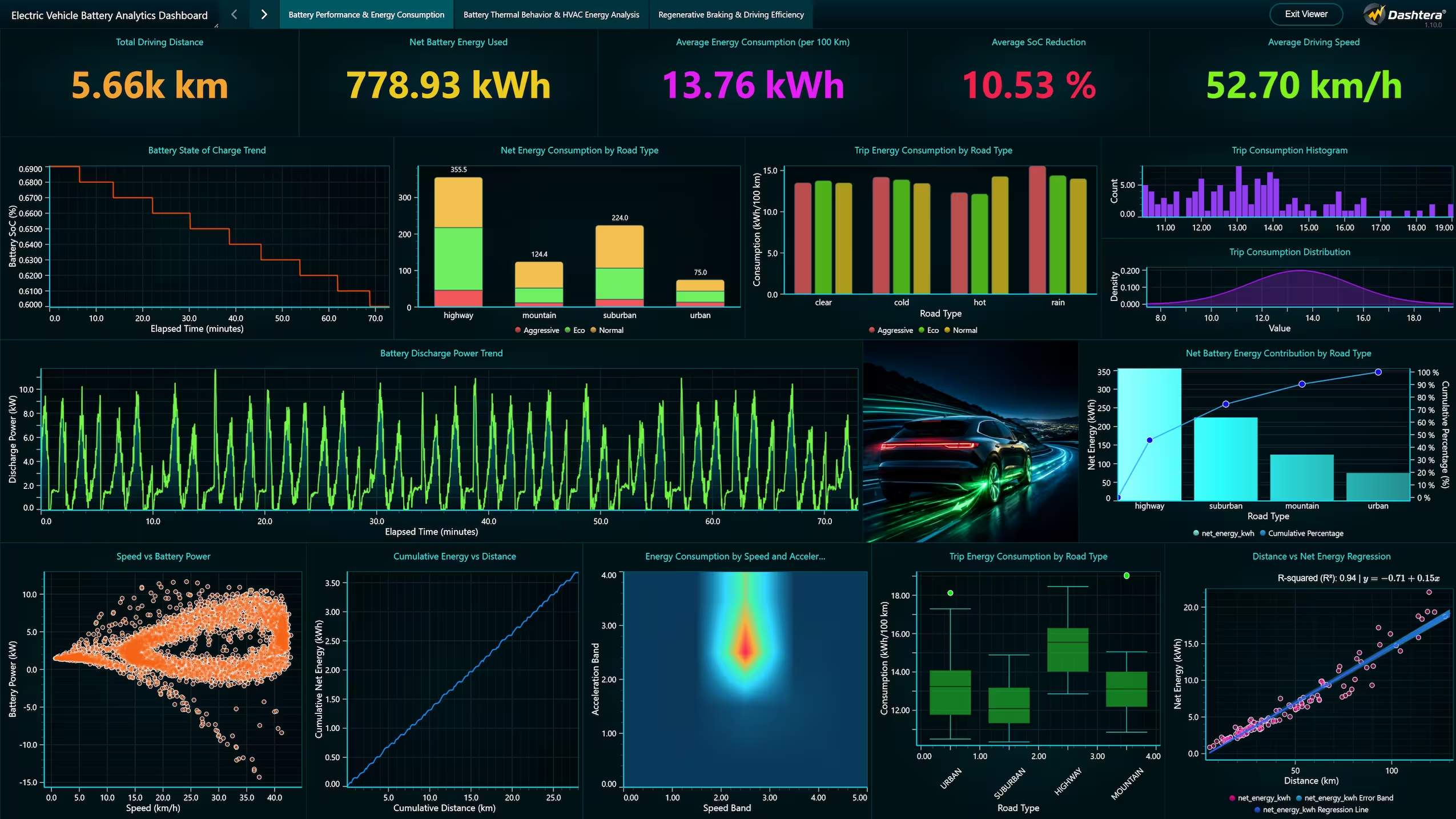
Prototyping often fails when it is tested against real-world data volumes, particularly in sectors like Fintech or industrial monitoring where data moves at microsecond intervals. While standard tools can handle basic bar graphs, they often fail when faced with millions of data points in real-time. Dashtera addresses this by utilizing the LightningChart JS engine, which can handle high-frequency data streams while remaining responsive on mobile devices and desktops alike. This capability allows a prototype to act as a mission control center where teams can monitor live telemetry and share insights instantaneously. Because the engine is built for volatility and volume, it can handle high-density charts without the lag that typically plagues early-stage prototypes.
Hardware-Level Performance for Massive Datasets
The limitation of most visualization tools lies in their reliance on the CPU and standard web technologies like SVG, which creates a performance ceiling when data density increases. Dashtera removes this ceiling by offloading the entire rendering process to the GPU, allowing for smooth interactivity even with datasets exceeding 100 million points. In a prototyping environment, this means that an engineer can throw massive amounts of raw data at a dashboard and receive an immediate, fluid response. This hardware-accelerated rendering is not just about visual appeal. It is a strategic requirement for organizations that need to turn massive datasets into actionable insights without the delay of waiting for a system to catch up with the incoming data.
Bridging the Gap Between Research and Decision Making
The goal of a prototype is often to convince stakeholders or executives of a specific direction. Dashtera bridges the gap between raw data science and executive decision-making by providing a professional-grade interface that requires very little setup time. Because the platform is collaborative, multiple teams can access the same high-frequency data from different locations, making it an ideal tool for collaborative research and rapid cloud deployment. This allows a prototype to transition from a technical test in a lab to a strategic presentation in a boardroom without needing to change the underlying technology stack. The low-code nature of Dashtera ensures that the person closest to the data. The analyst or researcher is also the one who can build the visualization, ensuring that nothing is lost in translation between teams.
The Seamless Path to Production Readiness
In traditional development, a prototype is often a “throwaway” piece of code that must be rewritten for production to ensure stability and performance. Dashtera eliminates this wasteful step. Because a Dashtera prototype is built on the same engine used for enterprise monitoring, the transition from a test case to a production-ready dashboard is nearly non-existent. The platform is not just a library, but a full-scale ecosystem designed for organizations that need high-performance dashboards without the overhead of building a custom infrastructure from scratch. This means that the time and effort invested in the prototyping phase are preserved, as the final dashboard is already living on a cloud-ready, collaborative, and secure infrastructure.
Economic Impact and Resource Optimization
The economic argument for using Dashtera in prototyping is centered on the significant reduction in time-to-value (TTV). While building a custom solution with a native library like LightningChart .NET might take weeks of specialized systems engineering, a Dashtera dashboard can be set up in minutes. This allows organizations to optimize their human resources, freeing up senior developers to work on proprietary business logic while data analysts handle the visualization through the Dashtera interface. By reducing the complexity of the development cycle, companies can iterate faster, respond to market changes more effectively, and ensure that their hardware is finally fast enough to keep up with the data volumes of 2026.
Dashtera provides the strategic foundation for any organization that needs to move at the speed of data. By removing the technical barriers of the past, it allows for a world of visual reality where the truth of the data is never hidden by the limitations of the software.