Rising healthcare costs have prompted insurance companies to adopt data-driven strategies for premium pricing and risk assessment. One powerful approach is leveraging visual analytics to uncover patterns behind medical expenses. In this project, Dashtera, a no-code data visualization platform, was used to build a comprehensive Medical Insurance Cost Prediction Dashboard. This dashboard highlights the factors driving medical charges and provides actionable insights for pricing policies and assessing risk.
Data
The dataset used consists of 2,772 records containing demographic and health-related variables that influence medical expenses. With 7 core attributes, it serves as a strong foundation for both analytics and machine learning models to forecast charges for new policyholders.
Dataset Source
The dataset was sourced from an open Kaggle repository titled “Medical Cost Personal Datasets”.
Variables:
Variable
Description
Age
Age of the individual (in years)
sex
Gender of the individual (Male/Female)
BMI
Body Mass Index (numeric value)
children
Number of children/dependents covered
smoker
Indicates whether the individual smokes (yes/no)
region
Geographical region of the policyholder
charges
Medical cost charged to the insurance provider (in Euro)
To enhance analytical insights, the dataset was expanded with the following categorized fields:
Variable
Description
Age Category
Young Adult, Adult, Middle-aged, Senior
BMI Category
Underweight, Normal weight, Overweight, Obese I, Obese II, Obese III
Family Size
No Children, Small Family, Medium Family, Large Family
Charges Category
Low, Moderate, High, Very High
About Dashtera
What is Dashtera?
Dashtera is a cloud-based, no-code dashboard platform that allows users to connect multiple data sources and create interactive dashboards without writing any code.
Key Features
Connects to various data sources (CSV, Excel, APIs, etc.)
Wide range of chart types, including advanced statistical visuals
Interactive drill-downs and dynamic filters
Shareable dashboards with flexible layouts
Supports calculated fields and transformations
User-friendly drag-and-drop interface
Advantages Over Similar Tools
Extremely easy to use—minimal technical expertise required
Rapid dashboard creation and deployment
Suitable for both beginners and advanced users
Lightweight yet powerful compared to Tableau or Power BI
Medical Insurance Cost Prediction Dashboard
The dashboard consists of two pages, each designed to highlight a distinct analytical perspective.
Factor Analysis
This page analyzes the distribution of insured individuals and total charges across various factors.
Key Insights:
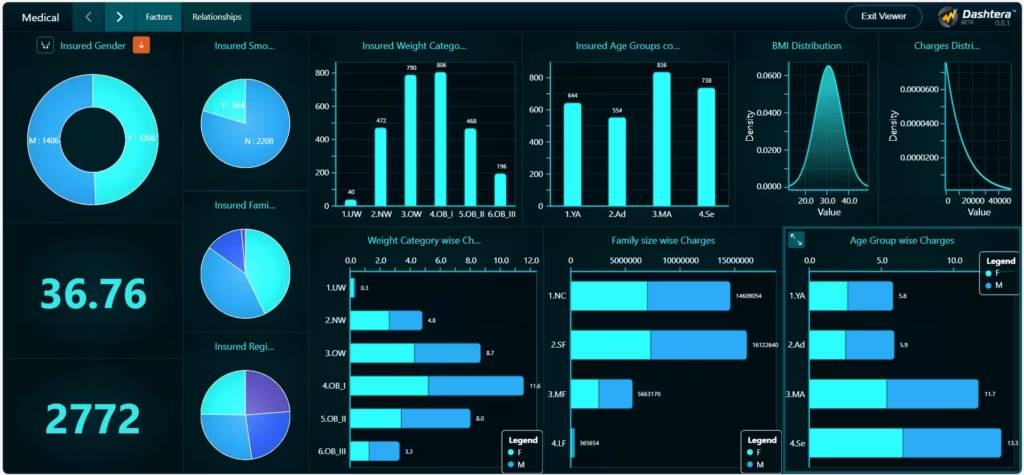
Gender Distribution – The insured population is nearly balanced: 1,406 males and 1,366 females. The gender pie chart supports drill-down by smoking status, family size, and region.
Total Charges – The dataset represents €36.76 million in medical expenses.
Total Insured – 2,772 policyholders are included.
Smoking Status – A donut chart reveals a significant proportion of smokers, highlighting their impact on higher charges.
Family Size Distribution – 43% have no children, and 42% belong to small families.
Regional Distribution – Insured individuals are nearly equally distributed across four regions.
BMI Categories – The largest group is Obese I (806), followed by Overweight (790), Normal weight (472), and Obese II (468).
BMI Distribution – BMI values are normally distributed.
Charges Distribution – Charges follow an exponential distribution, skewed towards higher values.
Weight Category vs. Gender (Stacked Bar Chart) – €11.6M comes from Obese I, €8.7M from Overweight, €8M from Obese II, and the lowest from Underweight at €0.3M.
Family Size vs. Gender (Stacked Bar Chart) – Small families contribute €16.1M, and individuals with no children contribute €14.6M.
Age Group vs. Gender (Stacked Bar Chart) – Seniors generate the highest charges at €13.3M, followed by Middle-aged at €11.7M, Adults at€5.9M, and Young Adults at€5.8M.
Relationship Between Age, BMI, and Medical Charges
This page explores how age and BMI contribute to variations in medical charges.
Key Insights:
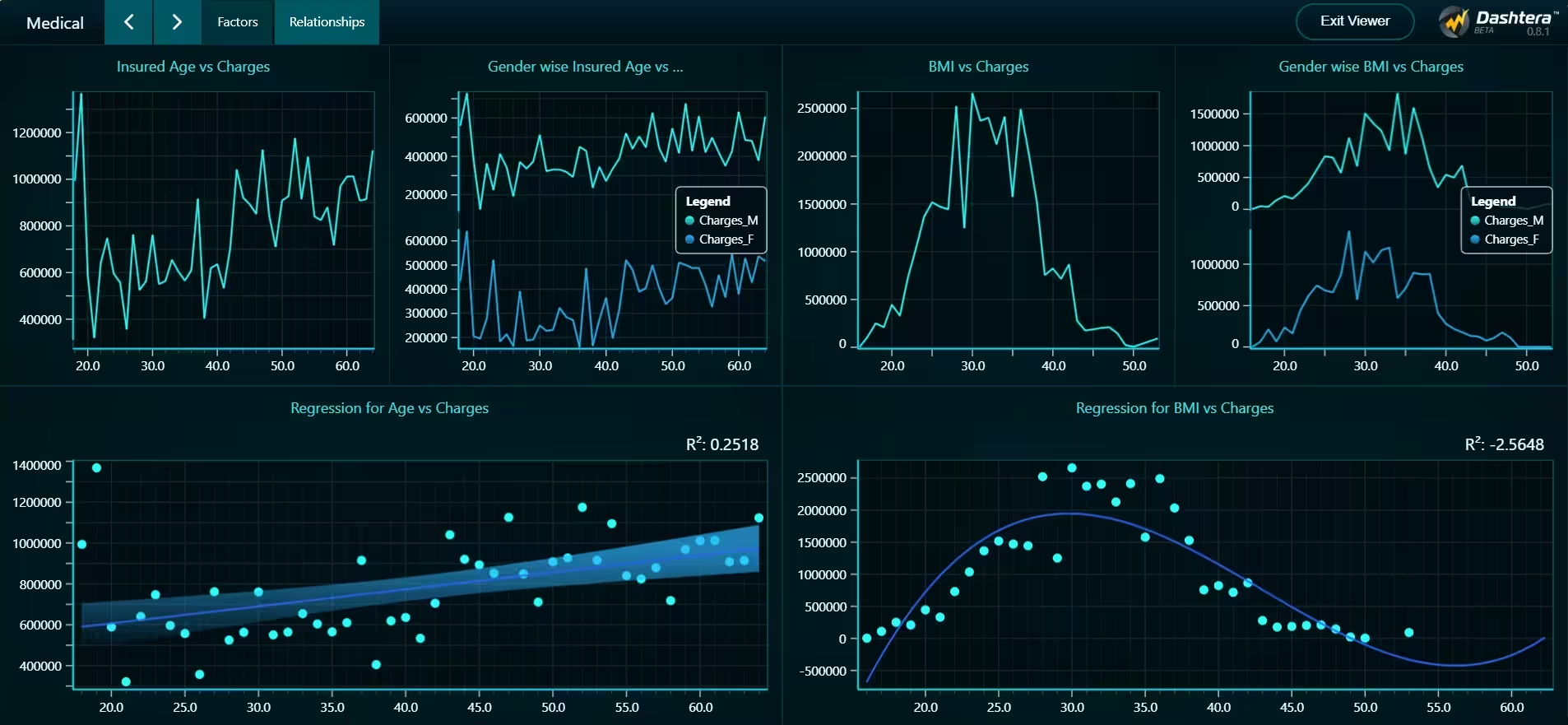
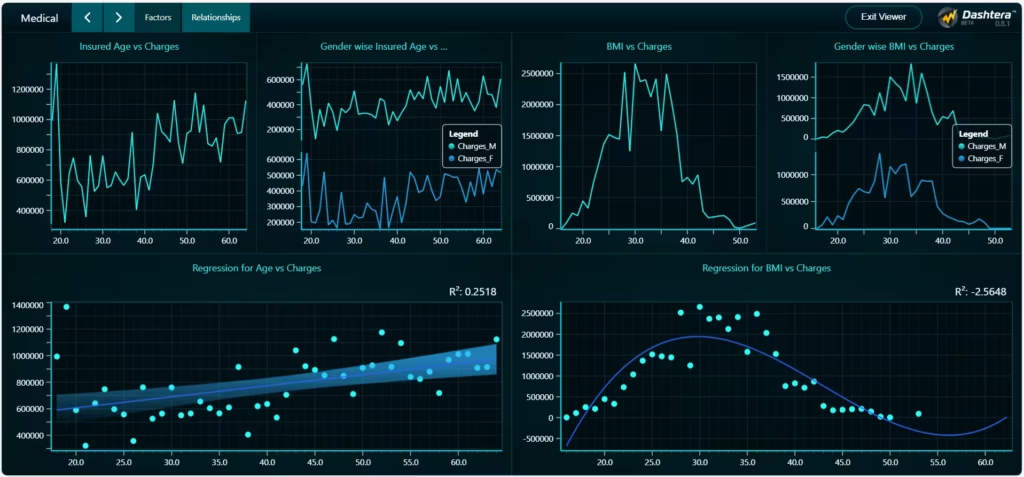
Age vs. Charges (Line Chart) – Charges increase steadily with age, indicating age as a strong cost driver.
Gender-wise Age vs. Charges (Line Chart) – The upward trend persists across both genders, with males slightly higher in older age groups.
BMI vs. Charges (Line Chart) – Higher BMI correlates with increased medical charges.
Gender-wise BMI vs. Charges (Line Chart) – Both male and female groups show similar upward trends with BMI.
Regression Analysis (Age vs. Charges) – Confirms a positive relationship, strengthening age as a predictive factor.
Regression Analysis (BMI vs. Charges): Polynomial regression captures the non-linear relationship between BMI and costs, showing that very high BMI values significantly elevate expenses.
Conclusion
Using Dashtera to analyze medical insurance costs proved to be both efficient and insightful. Within hours, the raw dataset was transformed into an interactive, drillable dashboard.
The analysis revealed that smoking status, age, and BMI are the primary cost drivers, with Seniors and Obese I policyholders contributing to the highest charges. The platform’s no-code interface and built-in statistical tools make it an excellent choice for analysts, business professionals, and decision-makers seeking to derive actionable insights without coding.
Whether for predictive modeling, risk assessment, or visual storytelling, Dashtera offers a streamlined solution for turning complex medical cost data into clear, impactful visual analytics.