

Want to see your data come to life?
Begin building your dashboards now, and unleash your creativity!


 Software Developer
Janaka Alwis
Software Developer
Janaka Alwis Insurance fraud remains a significant challenge for companies, leading to substantial financial losses and trust issues with policyholders. Leveraging data and visual analytics can help identify potential fraudulent claims early. In this project, I built a fraud detection dashboard using Dashtera, a powerful and easy-to-use data visualization platform.
The dataset used in this dashboard is a comprehensive auto insurance claims dataset that includes information about policies, claim amounts, policyholders, incidents, and whether fraud was reported. It contains 1,000 records with 39 attributes and is ideal for building a classification and anomaly detection model through visual insights.
The dataset was sourced from Kaggle under the project “Insurance Fraud Claims Detection”.
Key Variables and Their Measurement Units
Dashtera is a cloud-based, no-code dashboard visualization platform that empowers users to connect data from multiple sources and build insightful dashboards without writing any code. It’s designed for users across all levels of technical skill.
Main Features of Dashtera
Advantages Over Similar Platforms
Below is the insurance fraud detection dashboard created using Dashtera:
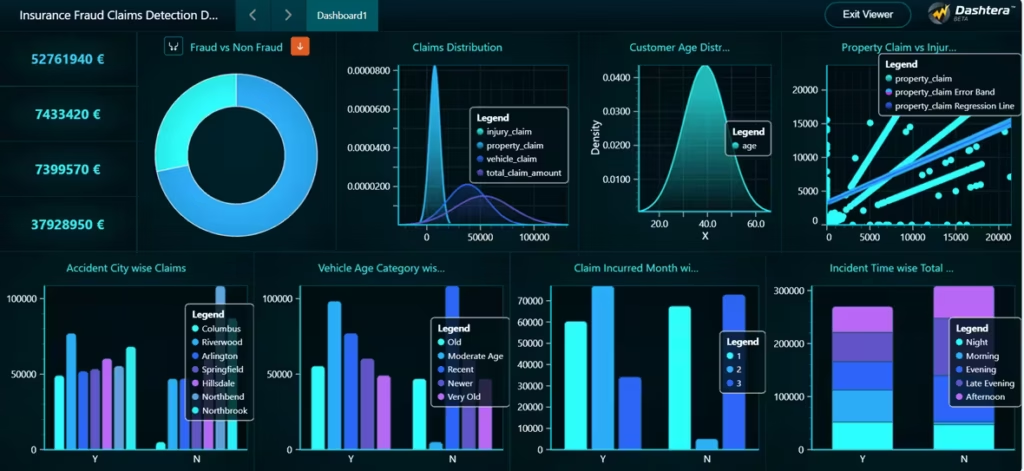
KPI Cards – Claim Amounts The KPI cards in the insurance fraud detection dashboard offer a quick financial overview by displaying overall claim values (in millions) for total_claim_amount, injury_claim, property_claim, and vehicle_claim. These large-scale values establish the financial context of the claims being analyzed.
Pie Chart – Fraud vs. Non-Fraud Distribution (with Drill Down feature) This essential chart for insurance fraud claims detection uses fraud_reported as the category and total_claim_amount as the value to show the percentage of total claim value associated with fraudulent versus genuine claims. A drill-down feature allows further investigation into vehicle age categories contributing to the fraud share.
Normal Distribution – All Claim Types To aid in insurance fraud claims detection, normal distribution curves are plotted for total_claim_amount, injury_claim, property_claim, and vehicle_claim. This visualization is critical for detecting anomalies or skewness in the distribution of different claim types.
Normal Distribution – Customer Age Another element of insurance fraud claims detection is understanding the policyholder demographics. This chart displays the distribution of customer age, helping analysts see which age groups are more frequently involved in claims.
Regression Chart – Property Claim vs. Injury Claim A key tool for correlation analysis in insurance fraud claims detection is this regression chart, which analyzes the relationship between property_claim and injury_claim. It helps detect suspicious patterns, such as whether higher injury claims are associated with higher property damage.
Bar Chart – Fraud by Accident City This bar chart is vital for geospatial insurance fraud claims detection, as it identifies cities with high fraud concentrations. It uses accident_city on the X-axis, categorized by fraud_reported, and valued by total_claim_amount.
Bar Chart – Fraud by Vehicle Age Category To improve insurance fraud claims detection, this chart displays fraud_reported status against total_claim_amount for different vehicle age categories: Moderate Age, Newer, Old, Recent, and Very Old. It helps pinpoint which vehicle age groups are more commonly associated with fraud.
Bar Chart – Monthly Fraud Trends An essential seasonal component of insurance fraud claims detection, this bar chart is based on the incident_date grouped by month. It categorizes by fraud_reported and values by total_claim_amount to spot seasonal fraud trends.
Bar Chart – Incident Hour Category vs. Fraud This chart contributes to effective insurance fraud claims detection by categorizing incident_hour into Night, Morning, Evening, Late Evening, and Afternoon. It displays fraud_reported versus total_claim_amount to detect specific time-of-day patterns where fraud claims are more common.
Working with Dashtera was an excellent experience. As someone who values both ease of use and analytical flexibility, I found the platform intuitive and powerful. I was able to upload my dataset, create insightful visualizations, and build an interactive dashboard all without writing any code.
Dashtera’s rich features such as statistical charts, drill-downs, and categorized filters helped me explore multiple fraud indicators efficiently. I highly recommend Dashtera for data analysts, business users, or anyone looking to explore data quickly and share compelling dashboards with their teams.
Share: