




 CEO, Head of R&D
Pasi Tuomainen
CEO, Head of R&D
Pasi Tuomainen
Real-time data visualizations are becoming increasingly important as the data becomes available from various sources, including devices, sensors, software systems, and cloud infrastructure. Getting fast-updating, minimal-latency, instantly responsive dashboards is a differentiating factor, e.g., when compared to typical BI dashboard use cases.
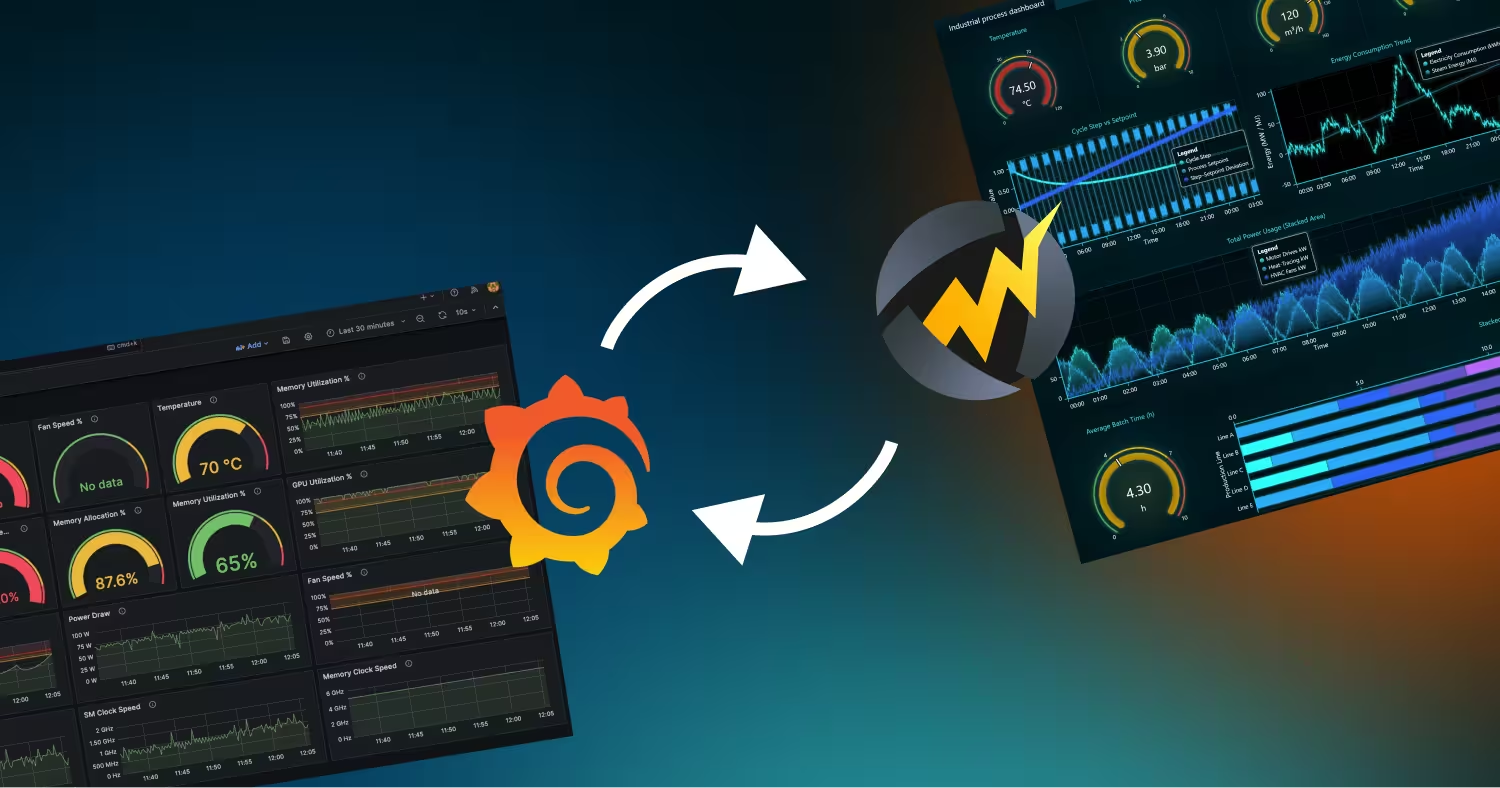
Almost all BI systems can update dashboards with the newest data available when opening the dashboard, or every few minutes. Only very few can do that every few seconds, and almost none can do it on a millisecond level. There are practically only 2 solutions that are capable of doing this: Dashtera by LightningChart Ltd, and Grafana by Grafana Labs. With these solutions, we are not talking about just getting an updated dataset through a SQL query but actually visualizing streaming real-time data.
Streaming real-time data enables many use cases: sensor data monitoring, medical monitoring, telemetry, vibration data monitoring, stock markets monitoring, audio data monitoring, radiofrequency (RF) monitoring, infrastructure and server status observability, and IoT devices monitoring.
Strengths: Grafana is a leading open-source platform for real-time monitoring and observability. It excels at connecting to a wide range of time-series databases (such as Prometheus, InfluxDB, Graphite, and others) and visualizing live data streams. Grafana’s dashboarding capabilities are highly customizable, with support for real-time updates, alerting, and interactive exploration.
Visualisation Types: Primarily focused on 2D charts (time series, gauges, heatmaps, tables, etc.). While it does not natively support 3D visualization, its plugin ecosystem allows for some extension, though not at the depth or performance level of Dashtera’s built-in 3D capabilities.
Deployment: Grafana is available as open source (self-hosted), paid Grafana Cloud (SaaS), and enterprise editions. It is widely adopted for IT infrastructure monitoring, DevOps, and IoT. Some added features and extensions are commercial and not free of charge.
Use Cases: Suitable for IT and server infrastructure monitoring, DevOps, and real-time observability where alerting is essential. Suit low data rate sensor and IoT devices for real-time visualization.
Strengths: Dashtera is designed for high-performance, real-time data visualization. It supports extremely high data throughput, with the ability to handle up to 1 billion data points and smooth, real-time scrolling of sub-millisecond data. This makes it ideal for scenarios requiring rapid updates, such as finance & trading, engineering monitoring, scientific, and medical applications.
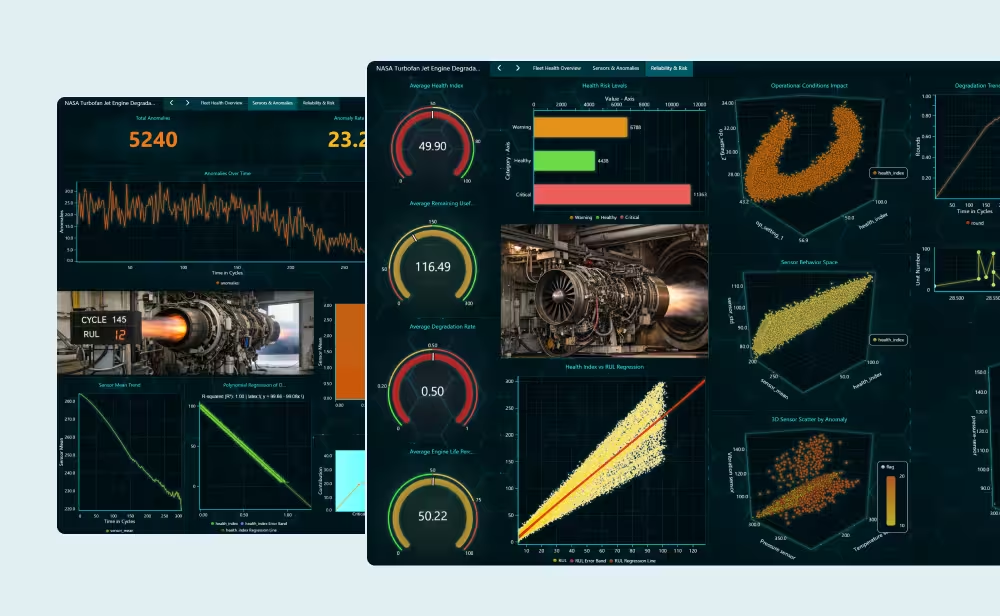
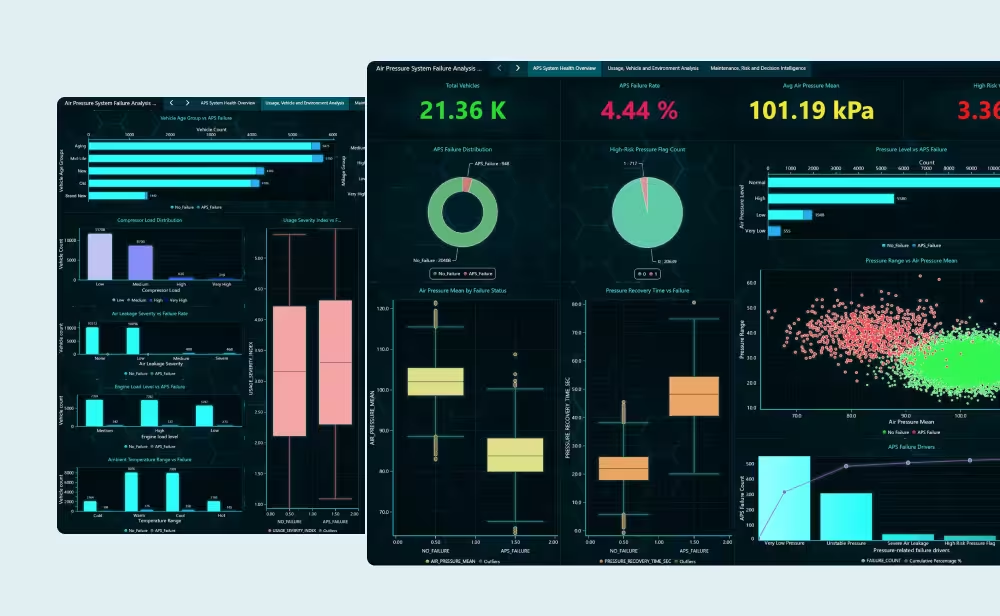
Visualization Types: Extensive support for both 2D and 3D charts, including real-time line charts, scrolling surfaces, rapidly updating point clouds, and KPI panels. Dashtera’s real-time capabilities are built in and optimized for large-scale, high-frequency data streams.
Deployment: Flexible deployment options (cloud, on-premises, custom), with built-in
integrations for databases, real-time streaming databases, data lakes, file uploads, and WebSocket connections for live data feeds.
Use Cases: Particularly strong in finance, engineering, medicine, and scientific domains where real-time, high-volume data is critical, and in Business Intelligence.
Grafana uses open-source charts, such as uPlot. They are HTML5 Canvas-based charts, but on the faster side of them. Dashtera uses the manufacturer’s proprietary WebGL rendering charting library, LightningChart JS, in the charts and Dashboard designer. WebGL is a more modern, higher-performance GPU-accelerated technology. The company behind Dashtera and LightningChart JS has pioneered GPU-accelerated data visualization technology innovation since 2007, before Grafana was established.
Charting libraries’ performance comparisons prove, Dashtera’s charting engine is up to ~379730 x faster in real-time streaming data applications, and up to 3400 x faster with static data than Grafana’s. Dashtera’s data visualization engine supports a variety of 3D charts, including surfaces, bars, lines, and 3D models.
Disclaimer: The charting technology performance numbers are not directly convertible as overall system performance – data architecture and integrations may affect system performance.
| Feature | Dashtera | Grafana |
|---|---|---|
|
Real-Time Data Handling |
Sub-millisecond updates, up to 1 billion points, smooth scrolling |
Real-time updates, depends on data source and backend |
|
Chart Types |
70+ 2D charts, extensive 3D charts, statistical charts, engineering charts, finance charts, trading charts, KPI panels. |
20+ 2D charts, No 3D built-in. |
|
Financial Visualizations |
Built-in technical analysis, 100 Technical Indicators, 30+ Drawing tools, multi-pane, multi-axis charts |
Candle-stick, Mountain, Line. No Technical Indicators or Drawing Tools |
|
Data Source Integration |
Databases, InfluxDB, file uploads, WebSocket, custom connectors |
Wide range: Prometheus, InfluxDB, MySQL, Elasticsearch, etc. |
|
Deployment |
Cloud, on-premises, custom |
Open-source, cloud, enterprise |
|
Pricing |
Free basic plan, modest advanced pricing |
Free (open-source), paid additional features, extensions and cloud/enterprise options |
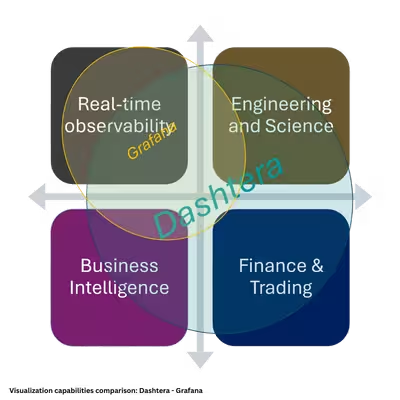
Grafana is known for IT and infrastructure monitoring, offering flexible, real-time dashboards and broad data source support. It is sufficient for many time-series for data visualizations, alerting, and observability, but is less focused on Business Intelligence, advanced 3D, or scientific/financial charting. Grafana’s main focus is on DevOps and engineering use cases, making it very hard to approach a wider audience. The high number of integrations and data connectors makes it popular.
Dashtera is an emerging, much stronger choice for organizations needing advanced BI and high-frequency real-time visualization, especially with large data volumes, 3D/engineering/finance charts, and scientific and medical applications. Its real-time streaming is built for sub-millisecond updates and massive datasets, having immediate responsiveness under heavy data loads. Dashtera is considerably easier to approach without prior education in data sciences or engineering. Dashtera enables fluent creation of BI projects, engineering projects, and finance projects, making it the optimal choice as the only data visualization solution needed by all teams across teams in all industries.
Share: