



 Data Analytics Software QA
Janaka Alwis
Data Analytics Software QA
Janaka Alwis
The Tata Motors NSE OHLCV Market Analysis Dashboard presents a comprehensive analytical exploration of intraday stock price behavior, trading volume dynamics, momentum indicators, trend-following metrics, and statistical characteristics of Tata Motors Limited (NSE: TATAMOTORS).
Developed using the Dashtera no-code business intelligence platform, the dashboard enables interactive, multi-dimensional analysis of minute-level OHLCV (Open, High, Low, Close, Volume) data enriched with widely used technical indicators such as RSI, MACD, EMA, Bollinger Bands, and derived statistical measures.
By integrating price action analysis, momentum tracking, volume behavior, trend confirmation, and statistical diagnostics across five structured dashboard pages, the system supports market trend interpretation, indicator-driven signal analysis, and quantitative exploration suitable for traders, analysts, and financial data science practitioners.
The dataset used in this project is sourced from the Tata Motors NSE OHLCV Dataset with Indicators, generated using AngelOne SmartAPI. It captures minute-level intraday trading data for Tata Motors Limited listed on the National Stock Exchange (NSE) of India.
In addition to raw OHLCV fields, the dataset integrates derived technical indicators, rolling volume statistics, momentum oscillators, trend indicators, statistical features, and scoring metrics. This combination enables both descriptive market analysis and advanced quantitative evaluation.
The dataset is particularly well-suited for intraday trading analysis, technical indicator validation, and market microstructure studies, where high-frequency data and indicator synchronization are essential.
Dataset Description
The dataset used in this study consists of minute-level intraday trading data for Tata Motors Limited, listed on the National Stock Exchange (NSE) of India. It includes standard OHLCV (Open, High, Low, Close, Volume) variables along with precise temporal identifiers such as timestamp and GlobalIndex, enabling synchronized time-series analysis.
In addition to raw price and volume data, the dataset incorporates a range of derived technical indicators and statistical features. These include trend indicators (EMA 50 and EMA 200), momentum oscillators (RSI, MACD, MACD Signal, and MACD Histogram), rolling volume averages, volume ratio, and candlestick pattern identification (Doji).
The dataset also contains market positioning metrics, such as the 52-week high and distance from the 52-week high, as well as a composite master score summarizing multiple indicator signals. Statistical descriptors, including median price, typical price, weighted close, skewness, kurtosis, and standard error, are provided to support quantitative characterization of price behavior.
Overall, the dataset is well-suited for intraday market analysis, technical indicator evaluation, and statistical exploration of financial time series within an interactive dashboard environment.
Dashtera is a cloud-based, no-code analytics platform designed to support the visual exploration and analysis of complex datasets. The platform enables users to construct interactive dashboards without programming, allowing for efficient examination of multidimensional data through line plots, bar charts, maps, regressions, and statistical summaries. Its interface allows data to be filtered, compared, and inspected from multiple perspectives, which makes it suitable for exploratory data analysis tasks.
Key Features
Dashtera’s flexibility makes it particularly suitable for exploratory data analysis and predictive insight presentation in healthcare and insurance domains.
The dashboard is structured into five analytical pages, each designed to examine a distinct dimension of intraday market behavior for Tata Motors Limited. Together, these pages provide a comprehensive and systematic evaluation of price action, momentum, volume dynamics, trend structure, and statistical characteristics using synchronized visual analytics.
The first dashboard page focuses on foundational price action analysis using classical technical analysis techniques.
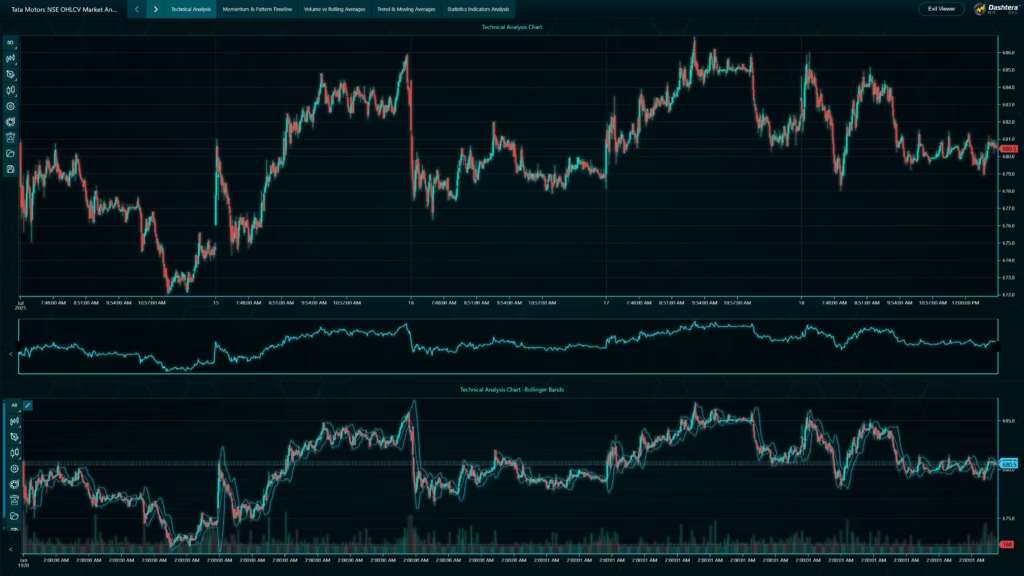
The Technical Analysis Chart with Zoom Band facilitates detailed inspection of minute-level price movements by enabling temporal zooming. This allows the examination of short-term price fluctuations, intraday volatility clustering, and micro-trend formations.
The Technical Analysis Chart with Bollinger Bands and Volume integrates volatility estimation with trading activity. Bollinger Bands provide a dynamic measure of price dispersion, while the volume overlay enables assessment of whether volatility expansions or price breakouts are supported by increased market participation.
Collectively, the visualizations on this page establish the baseline market structure and serve as a reference for interpreting subsequent momentum, trend, and volume-based indicators.
The second dashboard page examines momentum dynamics and candlestick-based pattern signals through synchronized time-series visualizations.
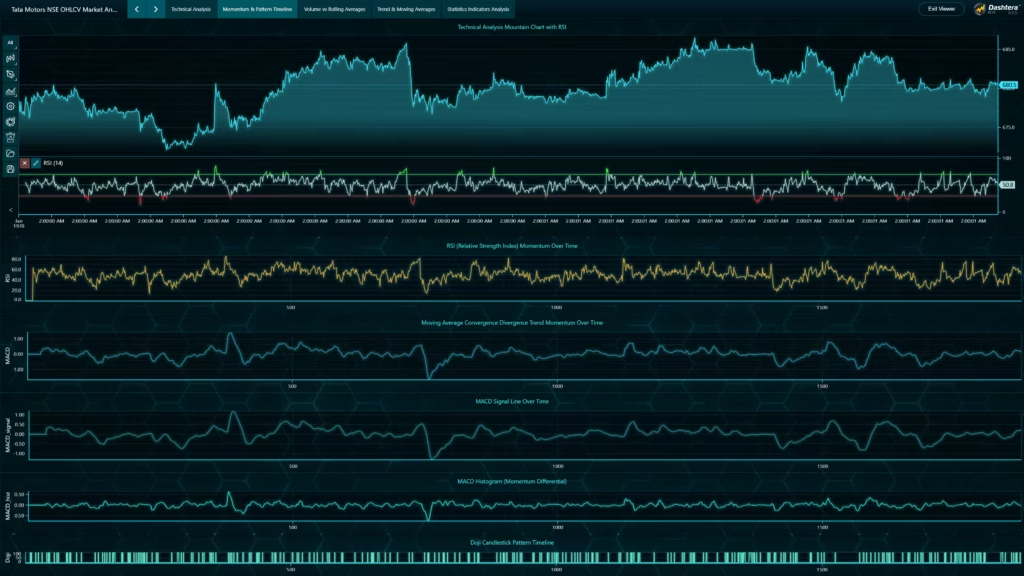
The Technical Analysis Mountain Chart with RSI highlights fluctuations in momentum intensity relative to price movements. The RSI Momentum Over Time chart quantitatively represents overbought, oversold, and neutral market conditions, facilitating the identification of potential exhaustion points.
The MACD Trend Momentum, MACD Signal Line, and MACD Histogram charts jointly capture trend direction, signal confirmation, and momentum acceleration or deceleration. By separating these components, the dashboard enables detailed evaluation of trend initiation, continuation, and weakening phases.
The Doji Candlestick Pattern Timeline identifies periods of price indecision, which are frequently associated with transitional market phases or potential reversals.
This page supports temporal alignment and comparative interpretation of multiple momentum and pattern indicators.
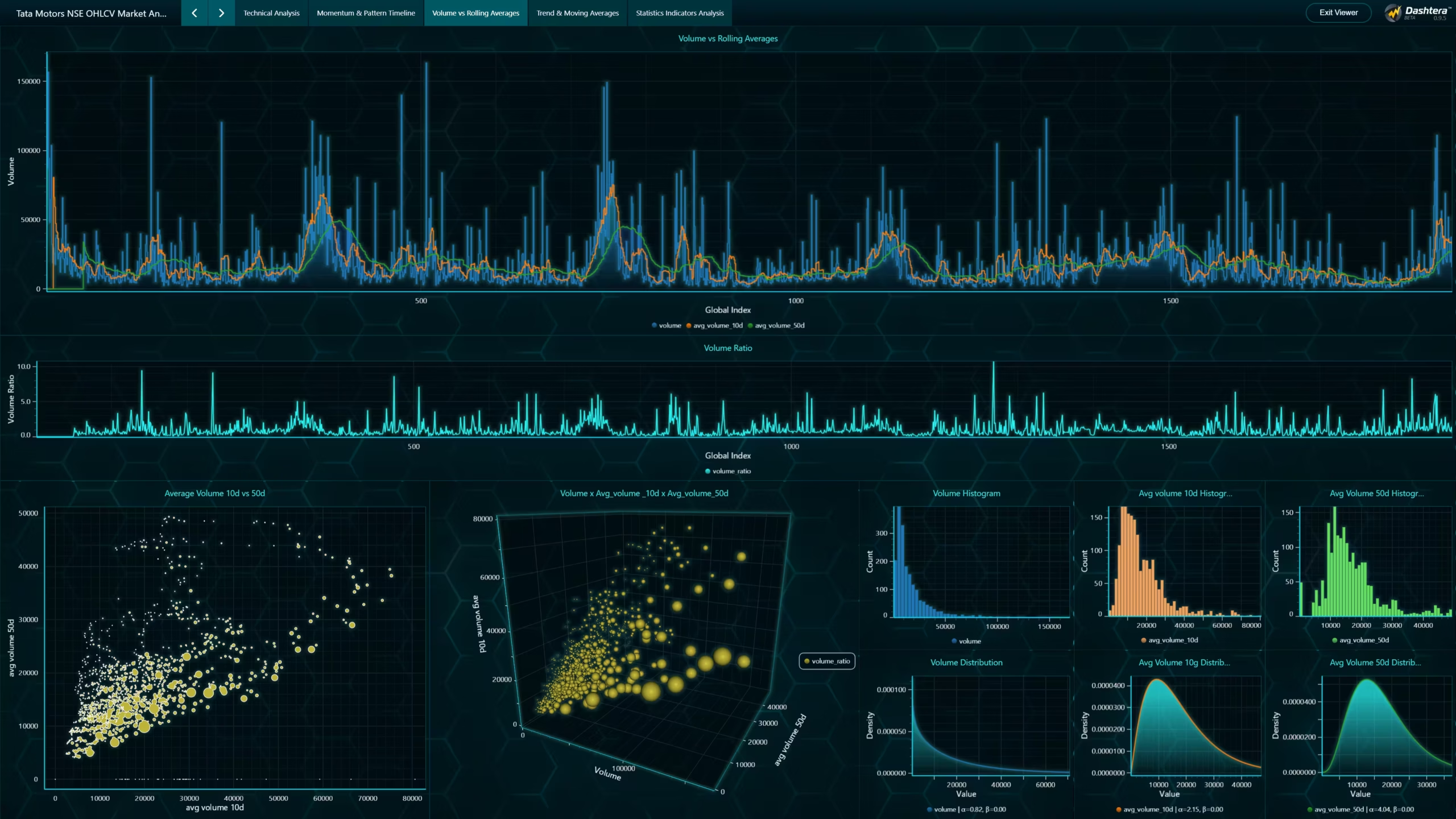
The third dashboard page focuses on trading activity and liquidity dynamics by comparing actual volume against historical benchmarks.
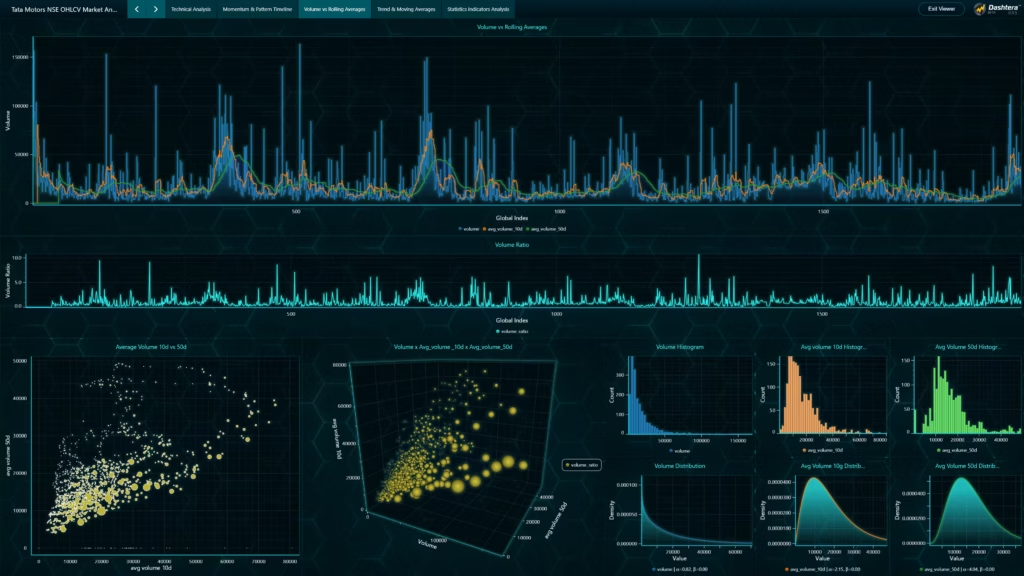
The Volume vs Rolling Averages Time Series contrasts real-time traded volume with 10-day and 50-day rolling averages, providing context for evaluating whether observed volume levels are typical or anomalous.
The Volume Ratio Time Series further quantifies deviations from historical norms, highlighting periods of heightened or subdued trading interest.
The Average Volume 10-day vs 50-day Scatter Plot examines the relationship between short-term and long-term volume trends, while the Volume × Average Volume 10d × Average Volume 50d 3D Chart offers a multivariate perspective on liquidity behavior.
Distributional analysis using Volume Histograms and Gamma Distributions reveals the non-normal, right-skewed nature of volume data, which is characteristic of financial markets.
The fourth dashboard page investigates price trends and directional persistence using moving average techniques and regression analysis.
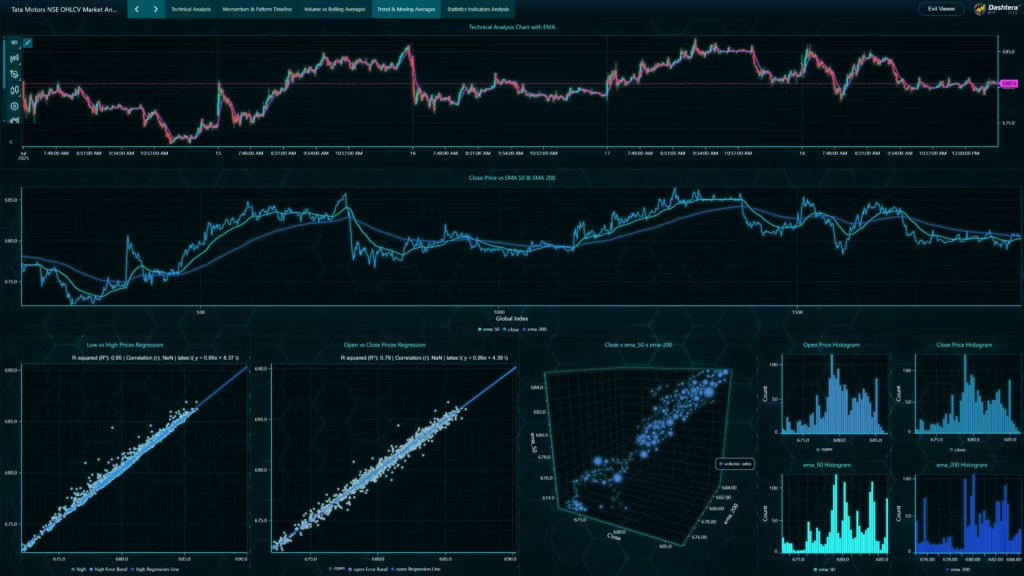
The Technical Analysis Chart with EMA and the Close Price vs EMA 50 & EMA 200 visualization assesses trend direction and relative price positioning with respect to short-term and long-term exponential moving averages.
Regression plots comparing Low vs High Prices and Open vs Close Prices evaluate intraday price symmetry and directional consistency.
The Close × EMA 50 × EMA 200 3D Chart integrates price and trend indicators into a unified analytical view, enabling examination of their joint behavior.
Finally, Price Histograms for Open, Close, EMA 50, and EMA 200 provide insights into the distributional alignment between raw prices and smoothed trend estimates.
The fifth dashboard page presents a statistical examination of intraday price behavior.
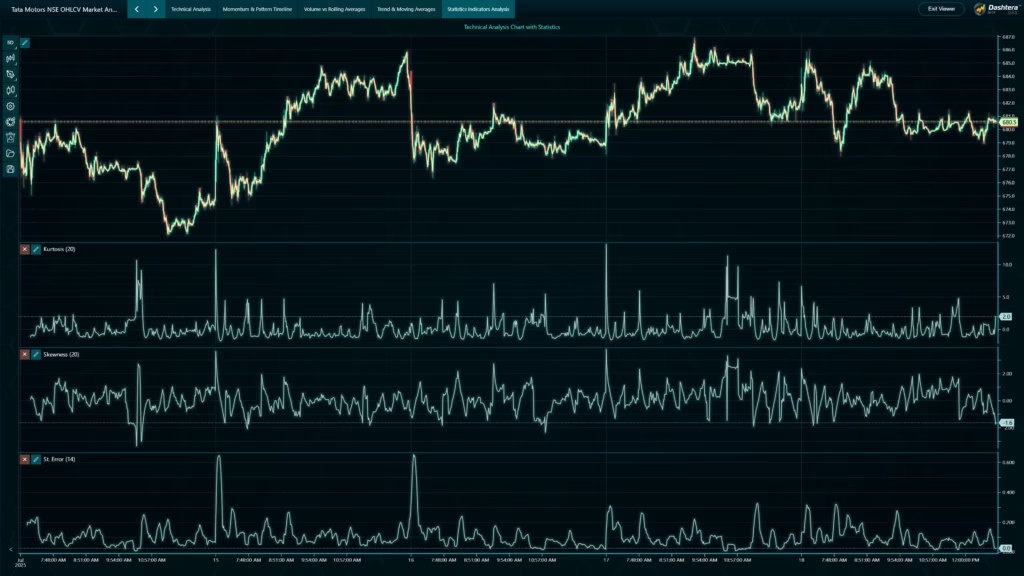
The Technical Analysis Chart with Statistical Measures incorporates alternative price representations, including median price, typical price, and weighted close, to assess central tendency under varying weighting assumptions.
Time-series plots of Kurtosis, Skewness, and Standard Error evaluate higher-order statistical properties of price distributions. These metrics provide insight into tail risk, asymmetry, and temporal variability, complementing traditional technical indicators with quantitative distributional diagnostics.
This page enhances the analytical framework by linking technical analysis with formal statistical characterization of market behavior.
The five-page dashboard presents a layered analytical approach to intraday stock market analysis.
Price action and volatility establish market structure, while momentum indicators reveal trend strength and potential reversals. Volume-based analysis confirms whether price movements are supported by sufficient market participation. Trend indicators provide directional bias, and statistical measures expose distributional characteristics and risk asymmetry.
The integration of synchronized time-series, distributional analysis, regression views, and 3D visualizations demonstrates how technical indicators and statistical metrics complement each other in understanding financial markets.
The Tata Motors NSE OHLCV Market Analysis Dashboard demonstrates the effective use of Dashtera as a no-code analytics platform for high-frequency financial data analysis.
The dashboard enables:
By combining descriptive analytics with technical and statistical indicators, the dashboard supports informed market interpretation and provides a scalable framework for further extensions such as strategy testing, signal scoring, and predictive modeling.
Share: