
Parkinson’s Telemonitoring Dashboard

Parkinson's-telemonitoring-dashboard-demographics

On this page

Introduction

Parkinson’s Disease (PD) is a progressive neurological condition that affects motor function, speech, and overall quality of life. Traditional assessments rely on clinical evaluations that may not capture subtle, day-to-day variations in symptoms. In this project, I used Dashtera, a no-code data visualization platform, to build a series of interactive dashboards that analyze voice recordings from Parkinson’s patients. This comprehensive Parkinson’s telemonitoring dashboard suite was created to uncover patterns related to disease severity and progression.

The dataset used to build the Parkinson’s telemonitoring dashboard includes 5,875 voice recordings from multiple patients over time, with measurements such as jitter, shimmer, noise ratios, and nonlinear voice features, along with clinical scores like motor and total Unified Parkinson’s Disease Rating Scale (UPDRS). By leveraging Dashtera’s drag-and-drop interface, I developed three detailed views to explore the demographics, voice patterns, and individual patient trajectories.

Dataset

The dataset used in this project captures acoustic features extracted from voice recordings, coupled with clinical UPDRS scores, demographics, and temporal information.

Key Variables:

  • Demographics: Subject ID, Age, Sex
  • Test Timing: Time since first recording (in days)
  • Clinical Scores: motor_UPDRS, total_UPDRS – indicators of Parkinson’s severity
  • Voice Metrics:
  • Jitter group – frequency variation
  • Shimmer group – amplitude variation
  • Noise Measures: HNR, NHR
  • Nonlinear Measures: RPDE, DFA, PPE

This dataset supports both individual patient monitoring and population-level pattern discovery.

Dashtera

Dashtera is a no-code, cloud-based data visualization platform ideal for quick statistical analysis, exploration, and storytelling. It empowers users to turn structured data into rich visual insights without writing a single line of code.

Main Features of Dashtera

  • Upload and connect CSV or Excel files
  • Supports histograms, box plots, regressions, spider charts, and more

Drag-and-drop chart creation

  • Enables calculated fields, transformations, and custom filters
  • Shareable, responsive dashboard layouts
  • Statistical overlays (e.g., confidence intervals, trends)

 Advantages Over Similar Platforms

  • Faster insight delivery with zero coding
  • Lightweight and intuitive—ideal for exploratory data work
  • Excellent support for statistical and health-related visualization

More accessible than platforms like Power BI or Tableau for quick projects

Parkinson’s Telemonitoring Dashboards

This section explains each dashboard component created in the Parkinson’s Telemonitoring dashboards project.

Demographic & Feature Distribution Dashboard
Parkinson's-telemonitoring-dashboard-demographics

Demographic Insights

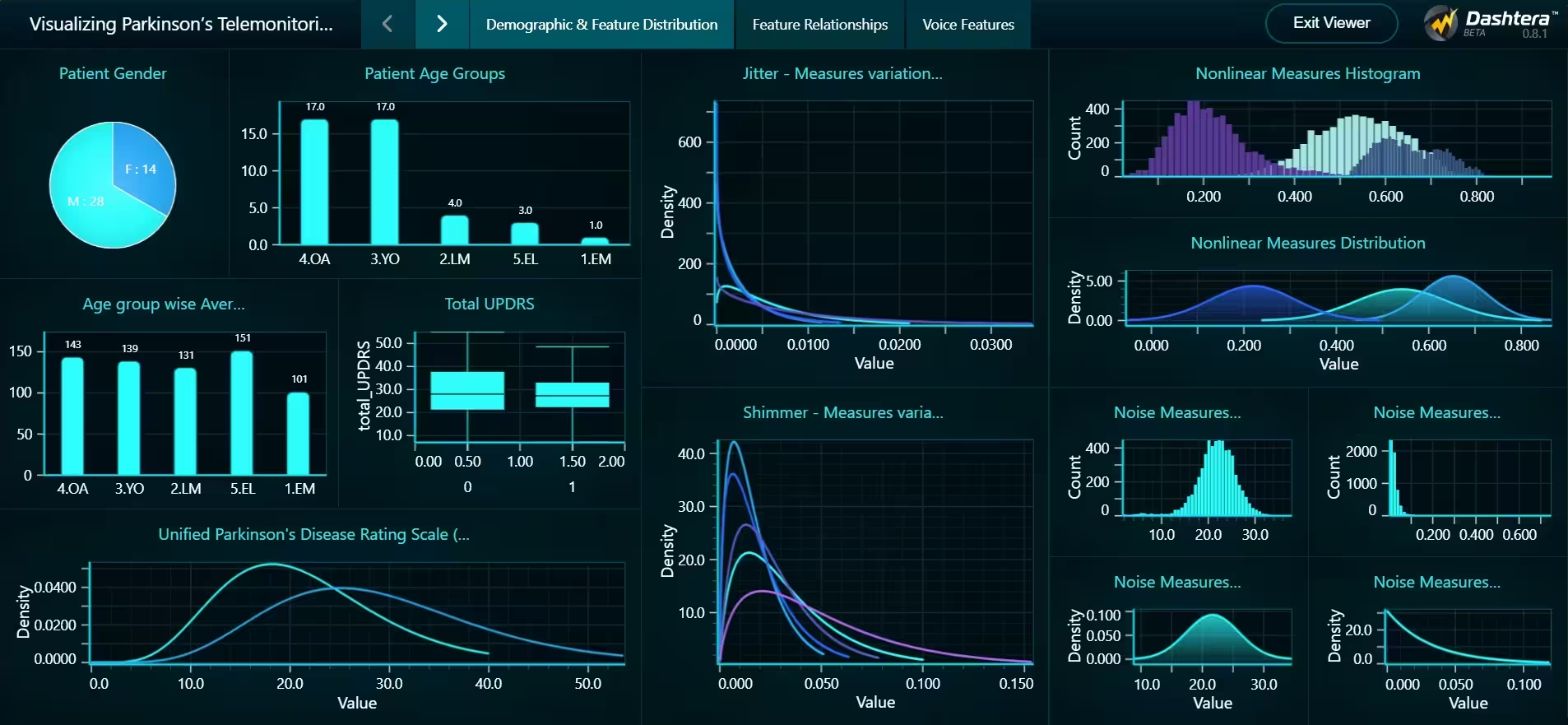
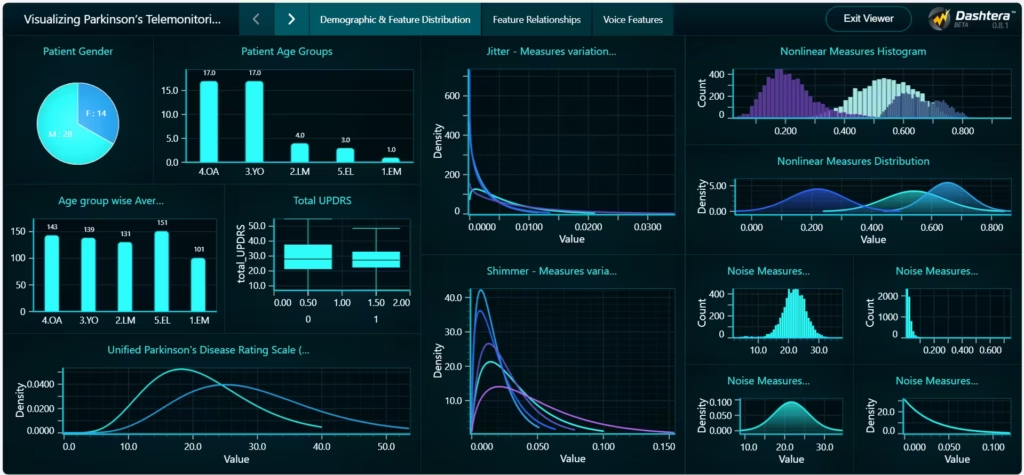
  • Sex Distribution: The dataset features a more male participant than female participants, not ensuring a balanced gender representation for analysis.
  • Age Group Classification: Participants are categorized into five life-stage groups:
    • Early Midlife (36–45)
    • Late Midlife (46–55)
    • Young Older (56–65)
    • Older Adult (66–75)
    • Elderly (76–85)

The bar chart shows a steady representation across all age groups, with a slight concentration in the older adult segment.

  • Average Test Time by Age Group: Older participants, particularly those in the Older Adult and Elderly groups, tend to have higher average test times—suggesting increased frequency of voice monitoring as Parkinson’s progresses.
  • Total UPDRS by Sex: The box plot illustrates variability in total_UPDRS scores across genders. Subtle differences suggest that symptom severity may present or progress differently between male and female patients, highlighting the need for gender-sensitive monitoring approaches.

Feature Distribution Insights

The Feature Distribution section provides a focused look at the acoustic variables and their statistical patterns across the dataset. These charts collectively highlight the variability in voice characteristics often associated with Parkinson’s Disease.

  • UPDRS Distribution: The distribution displays the spread of both motor_UPDRS and total_UPDRS scores. Most values cluster toward the lower-to-moderate range, indicating that many patients are in the early to mid-stages of Parkinson’s progression.
  • Jitter: This feature measures short-term pitch variation. The distribution reveals diverse pitch instability levels across patients, a common symptom in Parkinson’s-related speech impairment.
  • Shimmer: Shimmer reflects amplitude (loudness) variation. Similar to jitter, this metric varies across the dataset, pointing to a wide range of loudness irregularities among participants.
  • Noise Measures – Signal Noisiness: These charts (histogram and distribution) visualize overall signal clarity versus background noise. The spread indicates how noisy or clean each recording is, which directly impacts the detectability of Parkinsonian voice traits.
  • HNR – Harmonics-to-Noise Ratio: A higher HNR suggests clearer, more harmonic voice signals. The histogram and distribution show that many patients exhibit reduced clarity, which aligns with speech deterioration symptoms.
  • NHR – Noise-to-Harmonics Ratio: In contrast to HNR, a higher NHR signals greater vocal noise. The data reveals a significant portion of patients with elevated NHR values, reinforcing the presence of noise-related degradation in their voices.

Together, these visualizations offer a clear picture of voice degradation patterns in Parkinson’s patients, making it easier for clinicians to interpret acoustic symptoms in a diagnostic or monitoring context.

Feature Relationships Dashboard
Parkinson's-telemonitoring-dashboard-feature-relationships

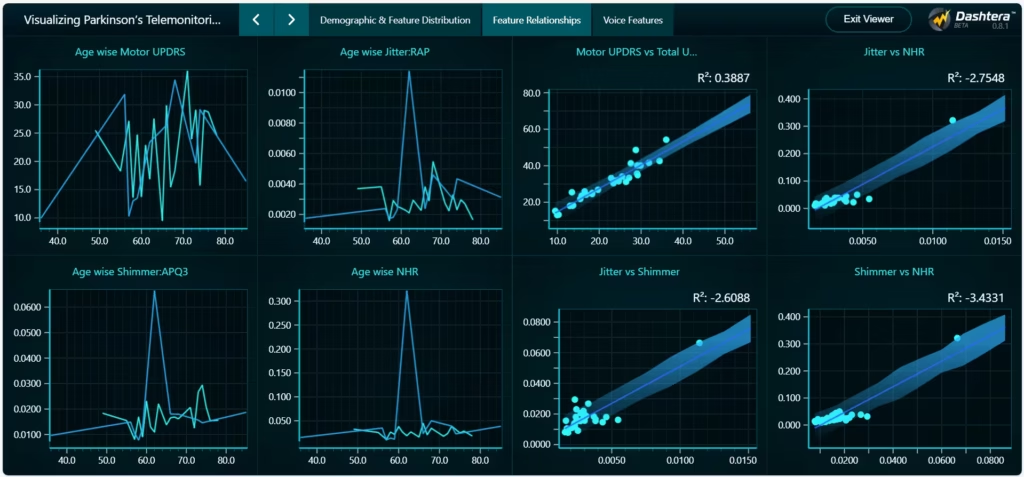
This dashboard investigates how voice features correlate with one another and how they vary with age and gender.

Feature Selection for Tracking

After aggregating voice data per patient:

  • Best jitter indicator: Jitter:RAP – consistent and well-aligned with shimmer patterns
  • Best shimmer indicator: Shimmer:APQ3 – shares a smoothing mechanism with RAP
  • Key noise metric: NHR – strongly correlated with both shimmer and jitter

Gender-Aware Line Charts

  • Motor UPDRS by Age and Gender: Reveals gradual increase in symptom severity with age, with some differences between males and females.
  • Jitter:RAP, Shimmer:APQ3, and NHR by Age and Gender: Subtle variations in vocal degradation across genders over time.

Regression Relationships

  • Motor UPDRS vs Total UPDRS: Strong linear relationship, as expected.
  • Jitter vs Shimmer: Voice pitch instability correlates with loudness instability.
  • Jitter vs NHR and Shimmer vs NHR: Both relationships reveal increasing noise as vocal irregularities grow.

These charts help clinicians spot trends and understand the interdependence of vocal features in Parkinson’s.

Random Patient Voice Feature Explorer Dashboard

Parkinson's-telemonitoring-dashboard-feature-relationships

This dashboard supports individual patient tracking by visualizing voice feature changes over time.

Patient-Specific Stacked Line Charts

By selecting a random patient, we observe how voice features evolve:

  • Chart 1: Jitter Features vs Test Time
    • Tracks fine-grained pitch irregularities (Jitter(%), Jitter(Abs), Jitter:RAP, etc.)
  • Chart 2: Shimmer Features vs Test Time
    • Shows amplitude variations (Shimmer, APQ3, DDA, etc.)
  • Chart 3: Noise Features vs Test Time
    • Observes clarity and noisiness (NHR, HNR)
  • Chart 4: Nonlinear Dynamics vs Test Time
    • Complex vocal instability (RPDE, DFA, PPE)

These visualizations enable doctors to quickly assess vocal degradation trends, making it easier to adjust treatments or schedule check-ins.

Conclusion

Using Dashtera, I built a comprehensive, interactive Parkinson’s telemonitoring dashboard suite that expertly profiles patients by age, sex, and symptom severity, while also analyzing key voice-based markers of disease progression. 

Furthermore, this Parkinson’s telemonitoring dashboard visualizes complex relationships between acoustic and clinical variables, enabling precise, individual patient monitoring using voice biomarkers. 

This project successfully demonstrates how no-code platforms can empower healthcare professionals and analysts to draw meaningful insights from clinical data—without writing a single line of code. 

In particular, Dashtera made it easy to transform thousands of voice recordings into actionable visual stories that reveal how Parkinson’s Disease impacts speech over time. 

Whether you’re a neurologist, data analyst, or researcher, this dashboard suite provides a powerful tool to understand and communicate the multifaceted dynamics of Parkinson’s Disease.

Share:

Read More

Want to see your data come to life?

Begin building your dashboards now, and unleash your creativity!

Dashtera-logo-for-dark
Privacy Overview

This website uses cookies so that we can provide you with the best user experience possible. Cookie information is stored in your browser and performs functions such as recognising you when you return to our website and helping our team to understand which sections of the website you find most interesting and useful.