
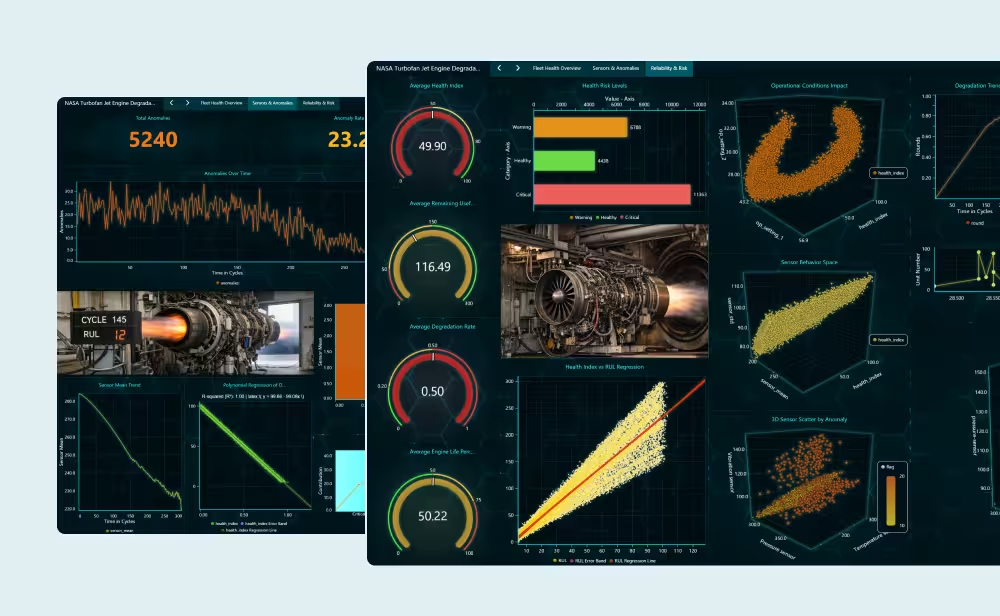

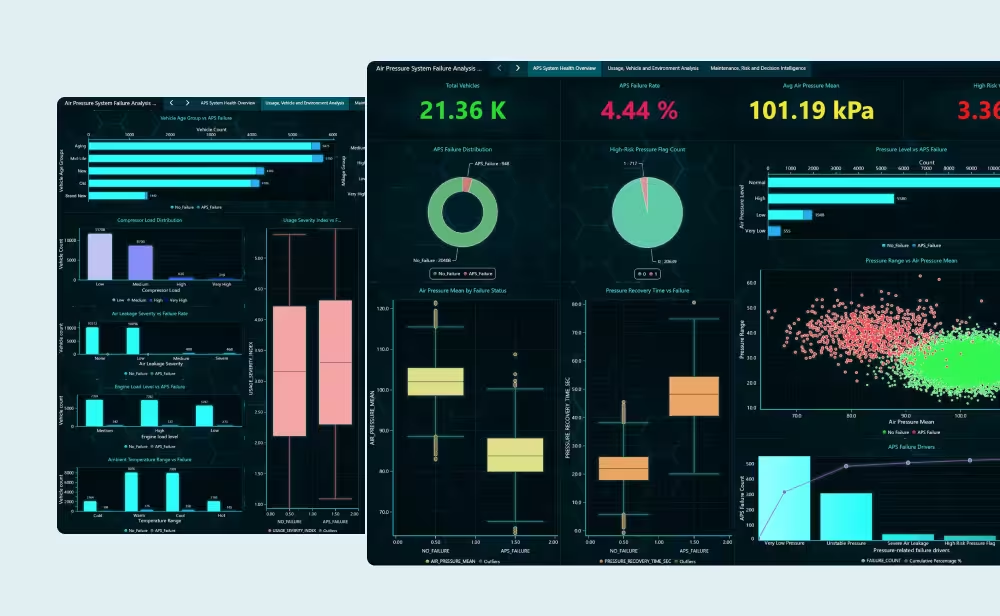
Want to see your data come to life?
Begin building your dashboards now, and unleash your creativity!



 Senior Developer
Jarkko Tirkkonen
Senior Developer
Jarkko Tirkkonen In the modern engineering landscape, data scientists are the architects of insight. They spend their days cleaning complex datasets, building predictive models, and uncovering the “why” behind system behaviors. However, a common bottleneck remains: the hand-off.
Traditionally, sharing these insights with the rest of the engineering team required a choice:
Send a static, non-interactive report.
Wait weeks for a software developer to build a custom internal tool.
No-code visualization is changing this story. Here is how data scientists are using these tools to become “Dashboard Heroes” and keep engineering teams moving at full speed.

For most data scientists, their expertise lies in Python, R, or SQL not in CSS, JavaScript, or front-end frameworks. Building a user interface from scratch is often a “coding tax” that takes time away from actual data analysis.
With a no-code dashboard builder, the interface is already there.
Drag-and-Drop Design: Instead of writing code to position a chart or a slider, you simply pick a component and place it.
Pre-Built Logic: The heavy lifting of making a dashboard responsive and interactive is handled by the platform.
Focus on the Data: You spend your time mapping data sources to visuals rather than debugging layout issues.
Engineering teams thrive on live data. Whether it’s monitoring a test bench or tracking production metrics, waiting for a weekly report is no longer enough.
No-code tools allow data scientists to connect directly to their data sources be it a database or a cloud stream. Once the connection is made, the dashboard updates itself. This gives the entire engineering team a “Single Source of Truth” that they can access via a web browser at any time. No more “Which version of the spreadsheet is this?” conversations.

A “Dashboard Hero” isn’t just someone who makes pretty charts; they are someone who makes data useful for everyone.
By using intuitive no-code tools, data scientists can create specialized views for different stakeholders:
For Managers: High-level KPIs and project health overviews.
For Field Engineers: Detailed trend lines and anomaly alerts.
For Stakeholders: Clear, visual proof of project progress.
Because the tools are easy to use, the data scientist can iterate on the dashboard based on team feedback in minutes, not days.
Transitioning from a code-heavy workflow to a visual-first approach is simpler than you think:
Start with the Goal: Ask your team, “What is the one metric you need to see every morning to do your job better?”
Connect Your Existing Data: Use built-in connectors to pull your cleaned data into the no-code environment.
Choose Your Components: Use gauges for status, line charts for trends, and tables for details.
Publish and Iterate: Get the dashboard into the hands of your team immediately. Their feedback will help you refine it into a tool they can’t live without.
The gap between data science and engineering operations is closing. By embracing no-code tools, data scientists can stop being “order-takers” for reports and start being the engine that drives team-wide visibility. You don’t need to be a web developer to build world-class tools you just need the right platform to let your data shine.
How can data scientists benefit from no-code tools?
No-code tools allow data scientists to bypass front-end development, allowing them to focus on data logic and deliver interactive insights faster to stakeholders.
What are the best dashboard tools for engineering teams?
The best tools focus on real-time data connectivity, high performance with large datasets, and ease of use like Dashtera’s no-code environment.
Do no-code dashboards replace data science coding?
No, they complement it. Data scientists still use code (Python, SQL) for data processing, but use no-code for the presentation layer to save time.
Share: