



 Software Developer
Janaka Alwis
Software Developer
Janaka Alwis
The Chronic Kidney Disease (CKD) Prediction Dashboard with Dashtera is a comprehensive interactive analytics tool designed to predict the likelihood of CKD in patients based on clinical, physiological, and demographic attributes. Built using Dashtera’s no-code platform, this dashboard transforms a real-world patient dataset into actionable insights through interactive charts, feature distributions, and predictive model outputs.
This dashboard helps healthcare practitioners and administrators to:
The dataset contains 400 patient records, each capturing 24 features including demographics, lab tests, medical conditions, symptoms, and the CKD diagnosis status (ckd / notckd).
The CKD dataset captures a wide range of patient attributes relevant for kidney health. Missing values are present in several features, which were handled during preprocessing.
| Feature | Description | Value / Unit |
|---|---|---|
|
age |
Patient age in years |
Numeric |
|
bp |
Blood Pressure |
mmHg |
|
hemo |
Hemoglobin |
g/dL |
|
pcv |
Packed Cell Volume |
% |
|
bgr |
Blood Glucose Random |
mg/dL |
|
bu |
Blood Urea |
mg/dL |
|
sc |
Serum Creatinine |
mg/dL |
|
sg |
Specific Gravity (urine) |
1.005–1.025 |
|
al |
Albumin (urine) |
0–5 |
|
su |
Sugar (urine) |
0–5 |
|
pc |
Pus Cells |
Normal/Abnormal |
|
rbc |
Red Blood Cells |
Normal/Abnormal |
|
pcc |
Pus Cell Clumps |
Present/Not Present |
|
ba |
Bacteria |
Present/Not Present |
|
htn |
Hypertension |
Yes/No |
|
dm |
Diabetes Mellitus |
Yes/No |
|
cad |
Coronary Artery Disease |
Yes/No |
|
ane |
Anemia |
Yes/No |
|
appet |
Appetite |
Good/Poor |
|
pe |
Pedal Edema |
Yes/No |
|
class |
CKD status |
ckd / notckd |
Derived & Processed Fields
What is Dashtera?
Dashtera is a no-code, cloud-based dashboarding platform that allows users to connect data sources, perform transformations, and build interactive visualizations without writing code. It’s ideal for quick insights, KPI tracking, and storytelling with data.
Key Features
Advantages Over Similar Tools
Demographics & Physiological Measures
This dashboard examines age, blood pressure, hemoglobin, and packed cell volume distributions and their relationship with CKD.
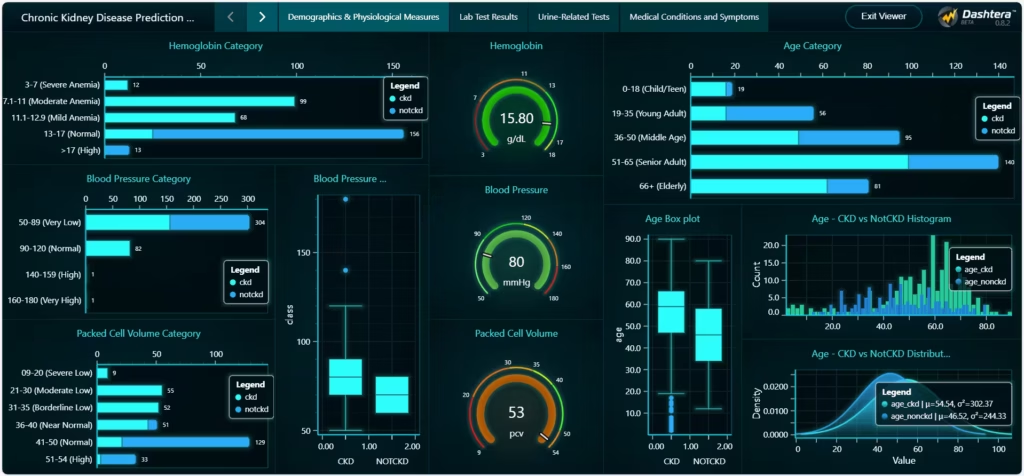
Dashboard provides an overview of patients’ age, blood pressure, hemoglobin, and packed cell volume distributions. Stacked bar charts highlight that CKD prevalence increases with age and is strongly associated with anemia and abnormal blood pressure levels. Box plots and gauge charts allow clinicians to quickly assess individual patient metrics, offering insights into the physiological conditions most linked to CKD.
Present in this visualization:
Hemoglobin Categories (Stacked Bar Chart) :
| hemoglobin_group | class | total_patients |
|---|---|---|
|
3–7 (Severe Anemia) |
ckd |
12 |
|
7.1–11 (Moderate Anemia) |
ckd |
99 |
|
11.1–12.9 (Mild Anemia) |
ckd |
68 |
|
13–17 (Normal) |
ckd |
25 |
|
13–17 (Normal) |
notckd |
131 |
|
>17 (High) |
notckd |
13 |
Blood Pressure Categories (Stacked Bar Chart) :
| bp_group | class | total_patients |
|---|---|---|
|
50–89 (Very Low) |
ckd |
156 |
|
50–89 (Very Low) |
notckd |
148 |
|
90–120 (Normal) |
ckd |
82 |
|
140–159 (High) |
ckd |
1 |
|
160–180 (Very High) |
ckd |
1 |
Packed Cell Volume Categories (Stacked Bar Chart) :
| pcv_group | class | total_patients |
|---|---|---|
|
09–20 (Severe Low) |
ckd |
9 |
|
21–30 (Moderate Low) |
ckd |
55 |
|
31–35 (Borderline Low) |
ckd |
52 |
|
36–40 (Near Normal) |
ckd |
43 |
|
36–40 (Near Normal) |
notckd |
8 |
|
41–50 (Normal) |
ckd |
21 |
|
41–50 (Normal) |
notckd |
108 |
|
51–54 (High) |
ckd |
3 |
|
51–54 (High) |
notckd |
30 |
Age Categories (Stacked Bar Chart):
| age_group | class | total_patients |
|---|---|---|
|
0–18 |
ckd |
16 |
|
0–18 |
notckd |
3 |
|
19–35 |
ckd |
16 |
|
19–35 |
notckd |
40 |
|
36–50 |
ckd |
49 |
|
36–50 |
notckd |
46 |
|
51–65 |
ckd |
99 |
|
51–65 |
notckd |
41 |
|
66+ |
ckd |
62 |
|
66+ |
notckd |
19 |
Lab Test Results
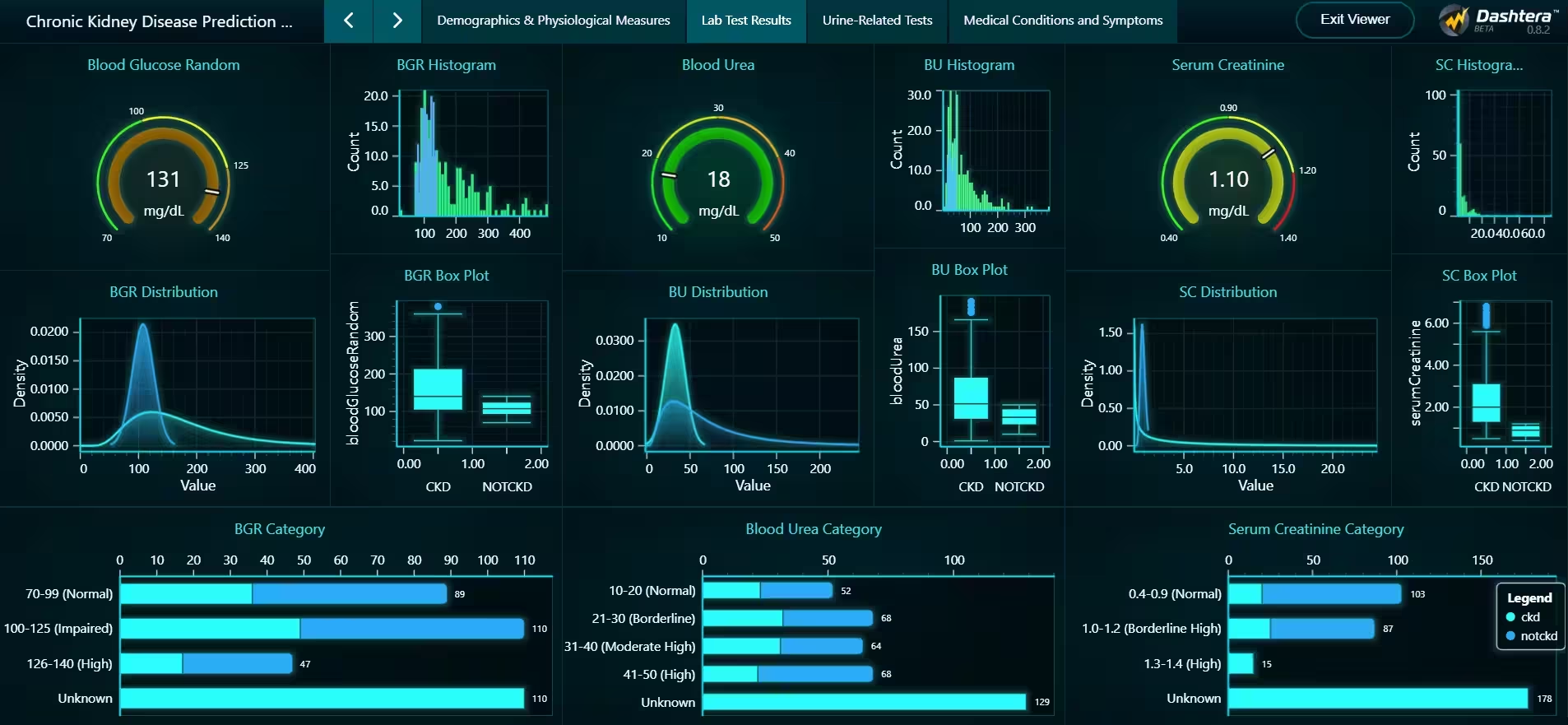
This dashboard analyzes blood glucose (BGR), blood urea (BU), and serum creatinine (SC).
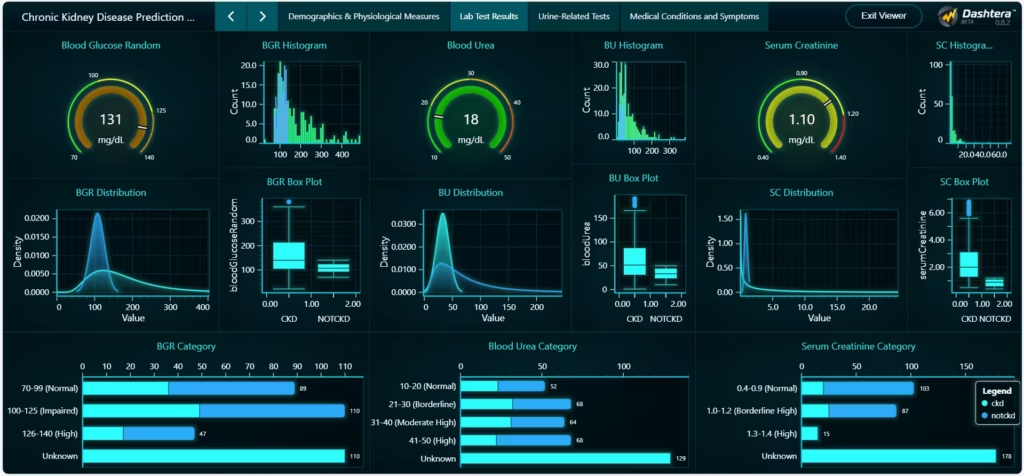
Lab test results including blood glucose (BGR), blood urea (BU), and serum creatinine (SC) are visualized to identify patterns indicative of CKD. Gauge charts and histograms show that higher BGR, BU, and SC levels are more common in CKD patients, while distribution and box plots reveal variability and outliers. Categorization into clinical ranges provides actionable thresholds for early diagnosis.
BGR Categories:
| bgr_group | class | total_patients |
|---|---|---|
|
70–99 (Normal) |
ckd |
36 |
|
70–99 (Normal) |
notckd |
53 |
|
100–125 (Impaired) |
ckd |
49 |
|
100–125 (Impaired) |
notckd |
61 |
|
126–140 (High) |
ckd |
17 |
|
126–140 (High) |
notckd |
30 |
|
Unknown |
ckd |
110 |
BU Categories:
| bu_group | class | total_patients |
|---|---|---|
|
10–20 (Normal) |
ckd |
23 |
|
10–20 (Normal) |
notckd |
29 |
|
21–30 (Borderline) |
ckd |
32 |
|
21–30 (Borderline) |
notckd |
36 |
|
31–40 (Moderate High) |
ckd |
31 |
|
31–40 (Moderate High) |
notckd |
33 |
|
41–50 (High) |
ckd |
22 |
|
41–50 (High) |
notckd |
46 |
|
Unknown |
ckd |
129 |
SC Categories :
| sc_group | class | total_patients |
|---|---|---|
|
0.4–0.9 (Normal) |
ckd |
20 |
|
0.4–0.9 (Normal) |
notckd |
83 |
|
1.0–1.2 (Borderline High) |
ckd |
25 |
|
1.0–1.2 (Borderline High) |
notckd |
62 |
|
1.3–1.4 (High) |
ckd |
15 |
|
Unknown |
ckd |
178 |
Urine-Related Tests
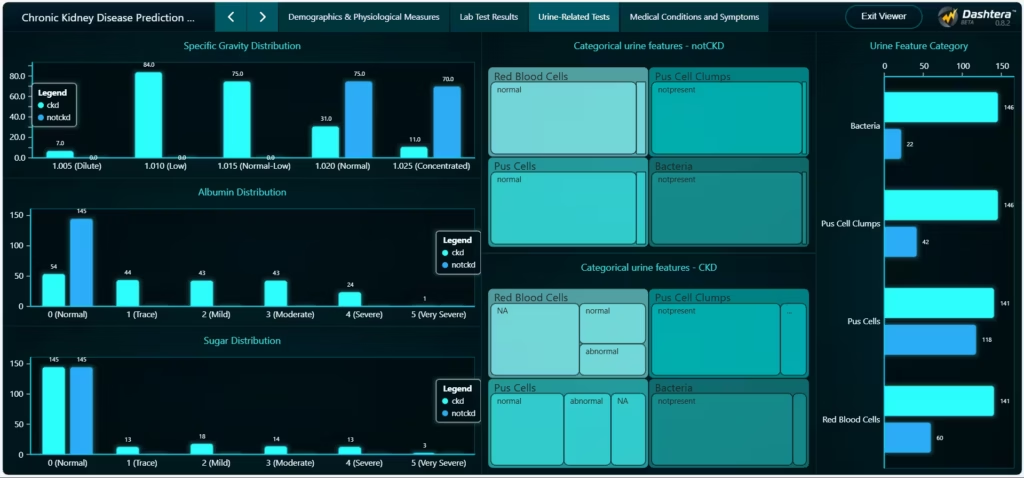
Urine analysis features such as specific gravity, albumin, sugar, pus cells, red blood cells, pus cell clumps, and bacteria are displayed to detect kidney function abnormalities. Vertical bar charts and treemaps distinguish CKD from non-CKD patients, highlighting that abnormal albumin levels, pus cells, and RBC irregularities are strong indicators of CKD. These visualizations support both patient-level assessment and population-level trends.
Specific Gravity (SG) :
| sg_group | class | total_patients |
|---|---|---|
|
1.005 |
ckd |
7 |
|
1.010 |
ckd |
84 |
|
1.015 |
ckd |
75 |
|
1.020 |
ckd |
31 |
|
1.020 |
notckd |
75 |
|
1.025 |
ckd |
11 |
|
1.025 |
notckd |
70 |
Albumin (AL) :
| albumin_group | class | total_patients |
|---|---|---|
|
0 (Normal) |
ckd |
54 |
|
0 (Normal) |
notckd |
145 |
|
1 (Trace) |
ckd |
44 |
|
2 (Mild) |
ckd |
43 |
|
3 (Moderate) |
ckd |
43 |
|
4 (Severe) |
ckd |
24 |
|
5 (Very Severe) |
ckd |
1 |
Sugar (SU) :
| sugar_group | class | total_patients |
|---|---|---|
|
0 (Normal) |
ckd |
145 |
|
0 (Normal) |
notckd |
145 |
|
1 (Trace) |
ckd |
13 |
|
2 (Mild) |
ckd |
18 |
|
3 (Moderate) |
ckd |
14 |
|
4 (Severe) |
ckd |
13 |
|
5 (Very Severe) |
ckd |
3 |
Medical Conditions & Symptoms
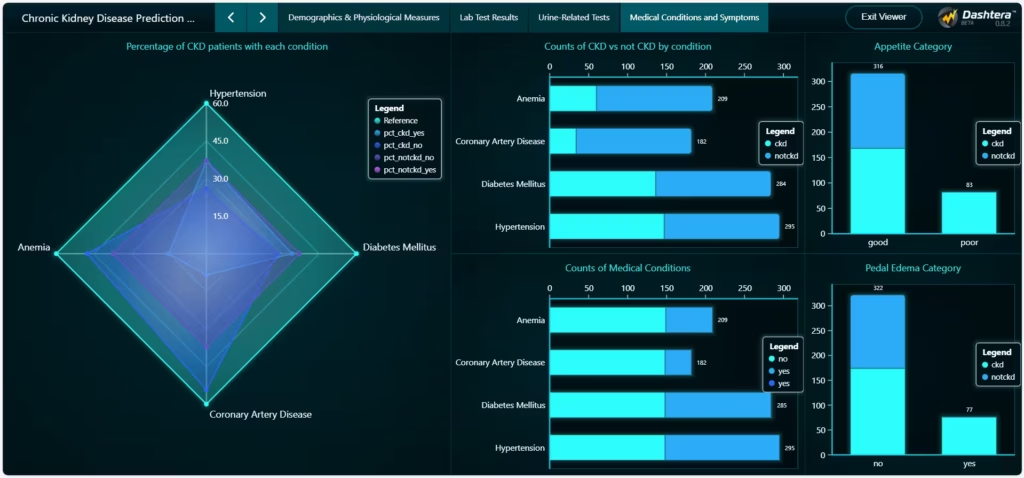
This dashboard examines comorbidities (hypertension, diabetes, coronary artery disease, anemia) and symptoms (appetite, pedal edema) in CKD patients. Spider charts reveal the proportion of CKD patients with each condition, while stacked bar charts show symptom prevalence. The visualizations emphasize that CKD frequently coexists with hypertension and diabetes, and that poor appetite or pedal edema are common clinical indicators.
Conditions (Spider Chart)
| feature | pct_ckd_yes | pct_ckd_no | pct_notckd_yes | pct_notckd_no |
|---|---|---|---|---|
|
Hypertension |
36.93 |
25.88 |
00 |
37.19 |
|
Diabetes Mellitus |
34.17 |
28.39 |
00 |
37.19 |
|
Coronary Artery Disease |
8.54 |
54.27 |
00 |
37.19 |
|
Anemia |
15.03 |
47.61 |
00 |
37.34 |
Symptoms (Stacked Bar Charts)
Overall Insights & Recommendations
The CKD Prediction Dashboard with Dashtera transforms a complex multivariate dataset into a user-friendly, interactive platform for early detection of chronic kidney disease. By integrating demographic, physiological, lab, urine, and symptom data, healthcare professionals can identify high-risk patients, improve early intervention, and make data-driven clinical decisions.
Using Dashtera’s no-code framework, the dashboard combines predictive analytics, visualization, and interpretability to support actionable healthcare insights.
Share: