



The E-Commerce Analytics Dashboard presents a comprehensive descriptive and statistical analysis of customer behavior, sales performance, marketing effectiveness, and operational efficiency within a simulated online retail environment. The dashboard was developed using the Dashtera no-code business intelligence platform and is designed to enable interactive, multi-layered exploration of e-commerce data through visual analytics.
By integrating executive-level KPIs, customer behavior analysis, probability distributions, regression modeling, and advanced statistical techniques across four structured dashboard pages, the system supports both business-oriented insights and statistical understanding. The project demonstrates how complex e-commerce datasets can be transformed into coherent analytical narratives using Dashtera’s visualization capabilities, making it suitable for learning business analytics, digital marketing analytics, customer intelligence, and applied statistics.
The dataset used in this project is a synthetically generated e-commerce dataset designed to simulate realistic online retail operations. It represents customer interactions, purchasing behavior, marketing engagement, and post-purchase experiences commonly observed in digital commerce platforms.
The dataset includes simulated customers across multiple age groups (Young Adult, Adult, Middle Age, Senior) and reflects realistic behavioral patterns such as order placement, session duration, discount usage, customer ratings, complaints, marketing interactions, and conversion behavior.
Although synthetic, the data follow statistically valid distributions (normal, binomial, Poisson, gamma, beta, log-normal, Weibull, etc.) and realistic business logic. This makes it well-suited for educational analytics, dashboard design, statistical visualization, and business intelligence storytelling.
Dataset Description
The dataset consists of several thousand transactional and behavioral records, where each record represents a customer interaction or order-related event.
Key attributes include:
This multidimensional structure enables analysis across financial performance, customer experience, marketing effectiveness, and statistical behavior.
Dashtera is a cloud-based, no-code analytics platform designed to support interactive exploration of structured datasets. It allows users to build sophisticated dashboards without programming, enabling rapid transformation of data into analytical insights.
Key Features
Dashtera’s flexibility makes it particularly suitable for e-commerce analytics, customer intelligence, marketing analytics, and applied statistical visualization.
The E-Commerce Analytics Dashboard is organized into four analytical pages, each focusing on a distinct layer of insight. Together, these pages form a structured analytical narrative progressing from executive-level performance indicators to advanced statistical and probabilistic modeling.
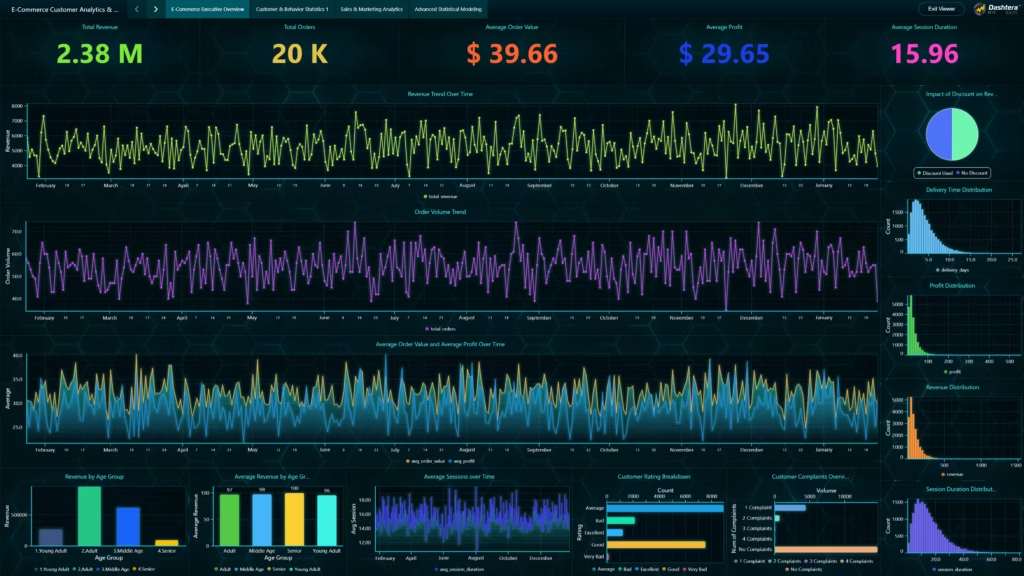
The first dashboard page provides a high-level overview of overall business performance. Its objective is to establish a clear understanding of revenue scale, order activity, customer experience, and operational variability.
Key Performance Indicators
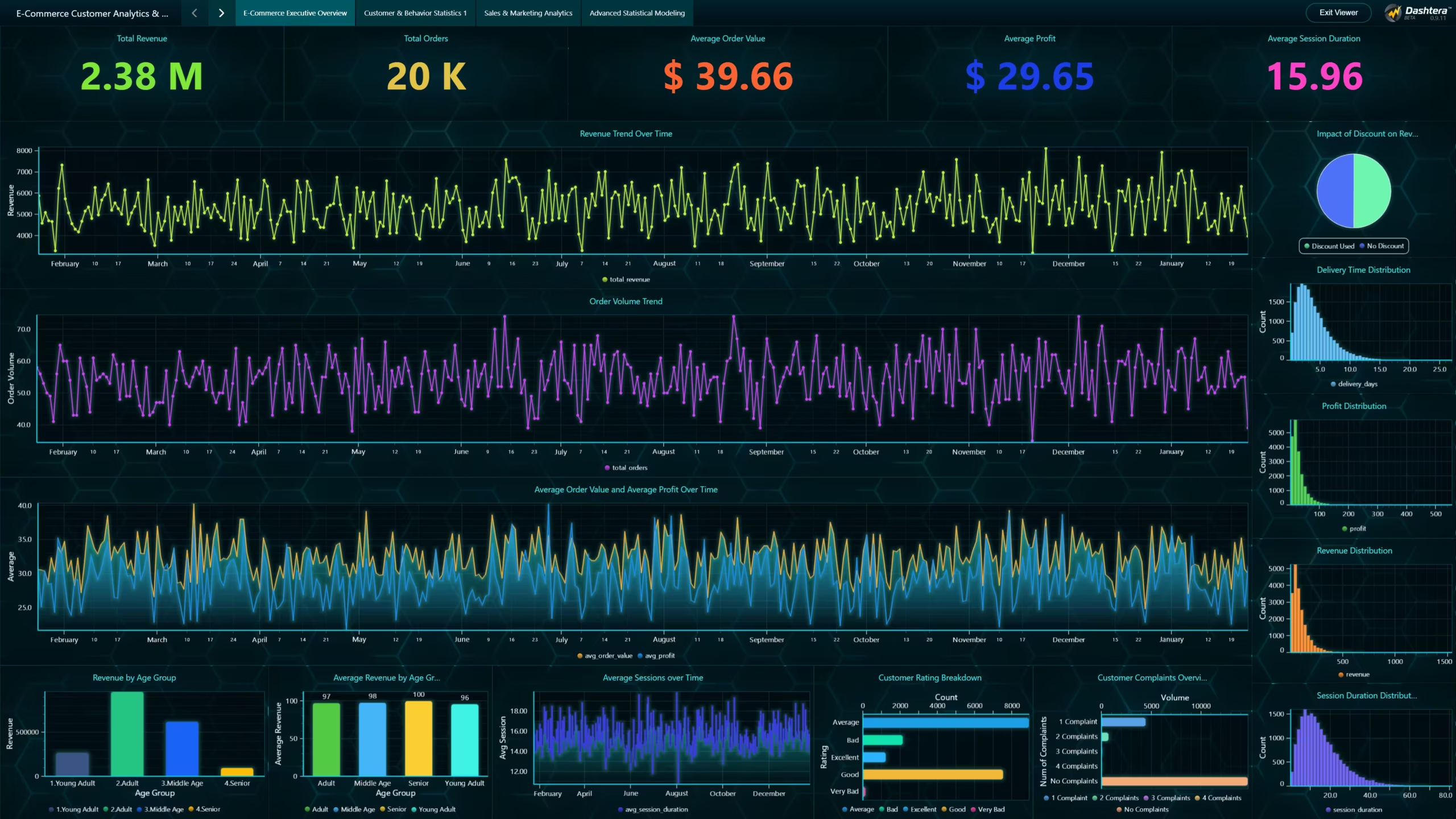
Five KPI cards summarize core business metrics. The total revenue generated is 2.38 million, derived from approximately 20 thousand orders, indicating a healthy transaction volume. The average order value is 39.66, while the average profit per transaction is 29.65, suggesting strong margins within the simulated business environment. The average customer session duration of 15.96 minutes reflects meaningful user engagement with the platform.
Collectively, these KPIs provide a concise executive snapshot of financial performance and customer interaction quality.
Revenue and Order Trends
Line chart analysis of revenue over time reveals a stable revenue trajectory with natural fluctuations reflecting daily or periodic variation in purchasing behavior. A corresponding order volume trend line shows consistent transaction activity, reinforcing the stability of demand within the simulated e-commerce environment.
These trends suggest a mature platform with predictable customer engagement rather than highly volatile or seasonal behavior.
Revenue by Customer Demographics
Bar chart analysis of average revenue by age category reveals relatively balanced spending behavior across demographic groups. Senior customers demonstrate the highest average revenue, followed closely by middle-aged and adult customers, while young adults show slightly lower average spending. This distribution reflects realistic consumer purchasing power patterns and supports demographic segmentation analysis.
Impact of Discounts on Revenue
Pie chart analysis comparing average revenue between discounted and non-discounted purchases shows minimal difference between the two groups. This suggests that discounts primarily influence purchase decisions rather than increasing transaction value, reflecting a common real-world retail phenomenon.
Customer Ratings and Complaints
Customer satisfaction is explored through bar charts of rating distribution and complaint counts. The majority of customers provide average or good ratings, with a smaller proportion reporting negative experiences. Complaint analysis shows that most customers report no complaints, while a decreasing number report one or more issues. This pattern indicates generally positive customer experiences with occasional service friction.
Distributional Analysis of Operational Metrics
Histograms of delivery time, profit, revenue, and session duration illustrate the natural variability of e-commerce operations. These distributions reveal right-skewed patterns typical of revenue and session-based metrics, reinforcing the realism of the dataset.
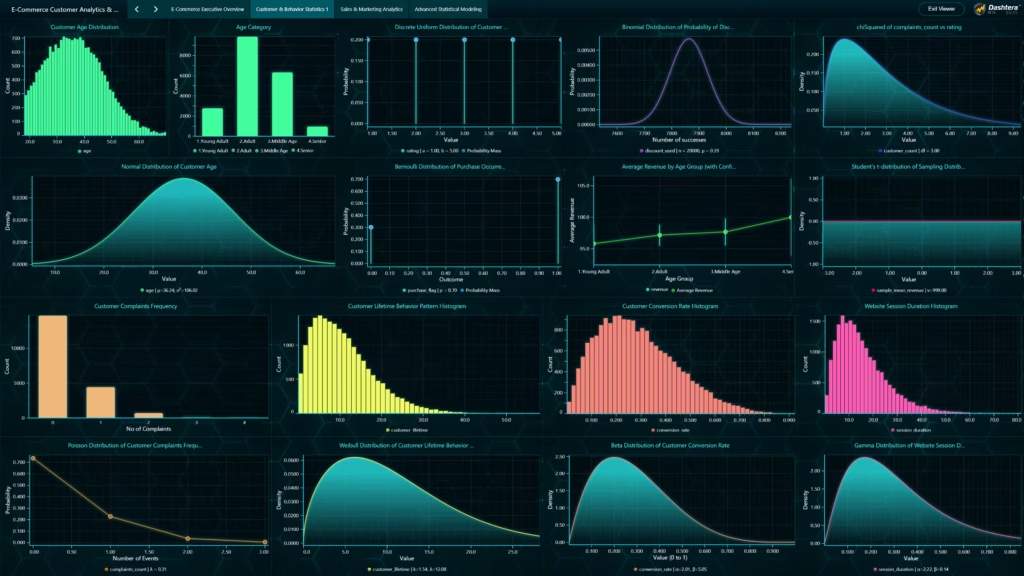
The second dashboard page focuses on statistical characterization of customer attributes and behavioral variables using probability distributions and hypothesis testing.
Customer Demographics and Ratings
Histogram and normal distribution plots of customer age show a bell-shaped distribution centered around the adult population. Discrete uniform distribution analysis of customer ratings confirms equal representation across rating levels, supporting unbiased rating simulation.
Purchase and Discount Behavior
Bernoulli and binomial distribution charts model purchase occurrence and discount usage probabilities. These charts demonstrate binary decision-making processes common in e-commerce platforms, such as whether a customer completes a purchase or uses a discount.
Complaints, Conversion, and Customer Lifetime
Poisson distribution modeling captures the frequency of customer complaints, highlighting that most customers report few or no issues. Beta distribution analysis of conversion rates reflects probabilistic customer conversion behavior bounded between zero and one. Weibull distribution modeling of customer lifetime illustrates customer retention and churn dynamics.
Statistical Inference and Hypothesis Testing
Confidence interval analysis of average revenue by age group provides interval-based comparisons rather than point estimates. A chi-square test explores the relationship between complaints and customer ratings, supporting categorical association analysis. Student’s t-distribution visualizes the sampling distribution of mean revenue, reinforcing foundational statistical concepts.
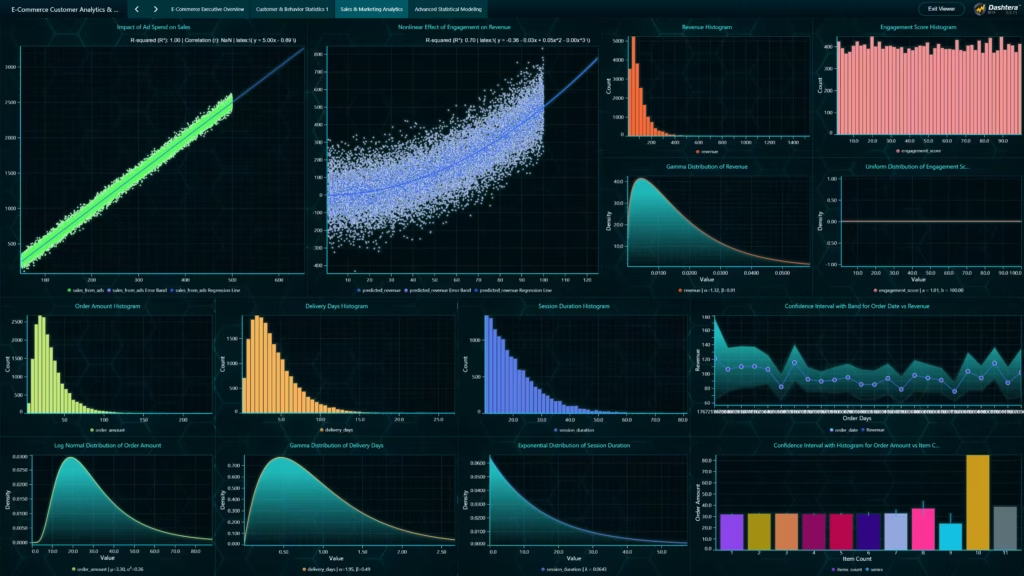
The third dashboard page examines relationships between marketing inputs, customer engagement, and financial outcomes using regression and continuous distributions.
Marketing Effectiveness
Linear regression analysis demonstrates a strong positive relationship between advertising spend and sales generated from ads. Polynomial regression further reveals nonlinear effects between customer engagement scores and predicted revenue, suggesting diminishing or accelerating returns at different engagement levels.
Financial and Operational Distributions
Revenue, order amount, delivery time, and session duration are modeled using gamma, log-normal, exponential, and related distributions. These models reflect real-world financial and operational behavior where values are strictly positive and often right-skewed.
Variability and Confidence Analysis
Confidence interval charts with bands illustrate revenue trends over time with uncertainty bounds. Additional confidence interval visualizations for profit and order amount variance support deeper understanding of financial stability. Fisher’s F-distribution analysis compares revenue variance across age groups, while uniform distribution validation confirms engagement score randomness.
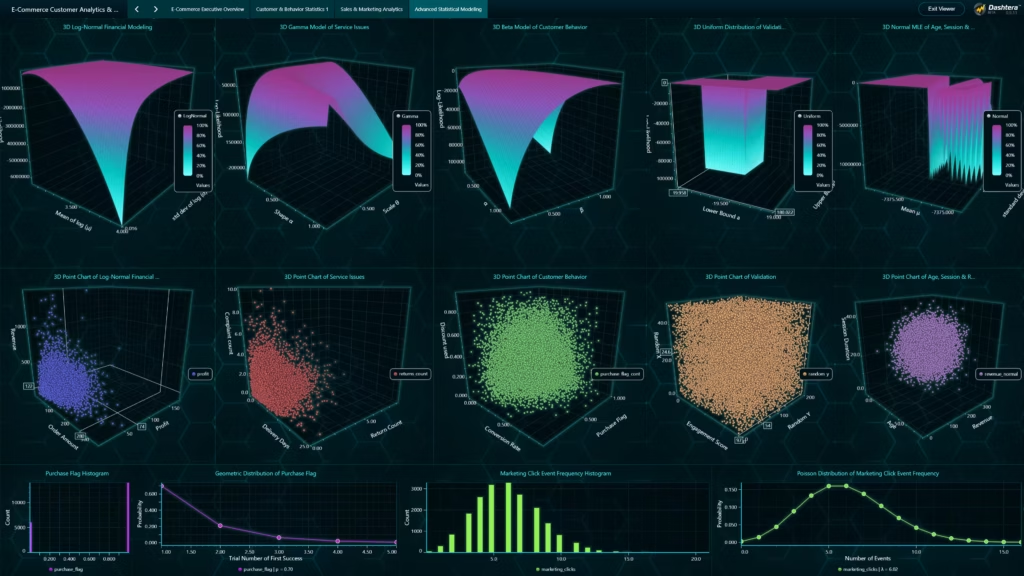
The final dashboard page introduces advanced statistical modeling using three-dimensional maximum likelihood estimation (MLE) and discrete probability distributions.
3D MLE Modeling
Five 3D MLE charts model multivariate relationships across customer behavior, financial performance, and service quality. Normal, log-normal, gamma, beta, and uniform distributions are applied to appropriate variable combinations, validating distributional assumptions in a multivariate context.
Discrete Probability Modeling
Discrete distribution charts model repeat purchase behavior and marketing click events. A geometric distribution visualizes the probability of repeat purchases over time, while a Poisson distribution captures the frequency of marketing clicks. These charts provide probabilistic insights into customer retention and marketing effectiveness.
The four-page E-Commerce Analytics Dashboard demonstrates a structured and progressive approach to data exploration. Executive KPIs establish scale and performance, statistical distributions explain customer behavior, regression analysis uncovers causal relationships, and advanced modeling validates underlying assumptions.
The integration of descriptive analytics, probability theory, regression modeling, hypothesis testing, and 3D statistical visualization illustrates how Dashtera can support both business decision-making and statistical learning within a unified platform.
The E-Commerce Analytics Dashboard highlights the effectiveness of Dashtera as a no-code platform for advanced business and statistical analytics. By combining executive insights, customer intelligence, marketing analysis, and advanced probabilistic modeling into a cohesive multi-page dashboard, the project provides a robust analytical framework applicable to real-world e-commerce environments.
The dashboard can be further extended toward predictive sales forecasting, customer churn modeling, recommendation systems, or optimization-based marketing strategies, making it suitable both as a portfolio project and as a conceptual prototype for enterprise-level e-commerce intelligence systems.
Share: