




The Physical Therapy Sensor Data Analysis Dashboard was developed using the Dashtera no-code analytics environment to examine wearable motion sensor data collected during physiotherapy exercises. The dataset, originally compiled by Aras Yurtman (KU Leuven) and Billur Barshan (Bilkent University), was designed to support research on the automated evaluation of physical therapy exercises using multiple wearable motion sensors. By transforming raw sensor readings into interactive visualizations, this dashboard aims to support physiotherapists, researchers, and data scientists in understanding movement patterns, comparing exercise sessions, and examining the contribution of individual sensor units to overall motion dynamics.
The dataset was recorded using five Xsens MTx sensor units, each equipped with tri-axial accelerometers, gyroscopes, and magnetometers. These sensors captured linear acceleration, angular velocity, and magnetic field intensity during human motion at a sampling rate of 25 Hz. Ethical approval for data collection was granted by the Bilkent University Ethics Committee.
The original research associated with this dataset can be found in:
Yurtman and Barshan (2014), Computer Methods and Programs in Biomedicine, 117(2), 189–207.
The dataset consists of:
For each subject and exercise, two session types are provided:
Each sensor unit includes:
| Sensor Type | Axes | Measurement |
|---|---|---|
|
Accelerometer |
acc_x, acc_y, acc_z |
Linear acceleration (m/s²) |
|
Gyroscope |
gyr_x, gyr_y, gyr_z |
Angular velocity (°/s) |
|
Magnetometer |
mag_x, mag_y, mag_z |
Magnetic field strength (µT) |
A review of the record distribution indicates that template sessions are smaller and more controlled, whereas test sessions contain approximately three to four times more samples. This structure provides a suitable foundation for both baseline comparison and variability analysis across exercises and subjects.
Dashtera is a cloud-based, no-code analytics platform designed to support the visual exploration and analysis of complex datasets. The platform enables users to construct interactive dashboards without programming, allowing for efficient examination of multidimensional data through line plots, bar charts, maps, regressions, and statistical summaries. Its interface allows data to be filtered, compared, and inspected from multiple perspectives, which makes it suitable for exploratory data analysis tasks.
Key Features
Relevance to This Project
Dashtera was selected for this study due to its ability to rapidly generate interactive, sensor-focused dashboards without additional software development overhead. Its lightweight configuration and visual workflow make it well suited for time-series comparison, motion pattern inspection, and exploratory analysis of multichannel sensor data.
Dataset Overview
The first dashboard provides a structural summary of the dataset across subjects, exercises, and session types.
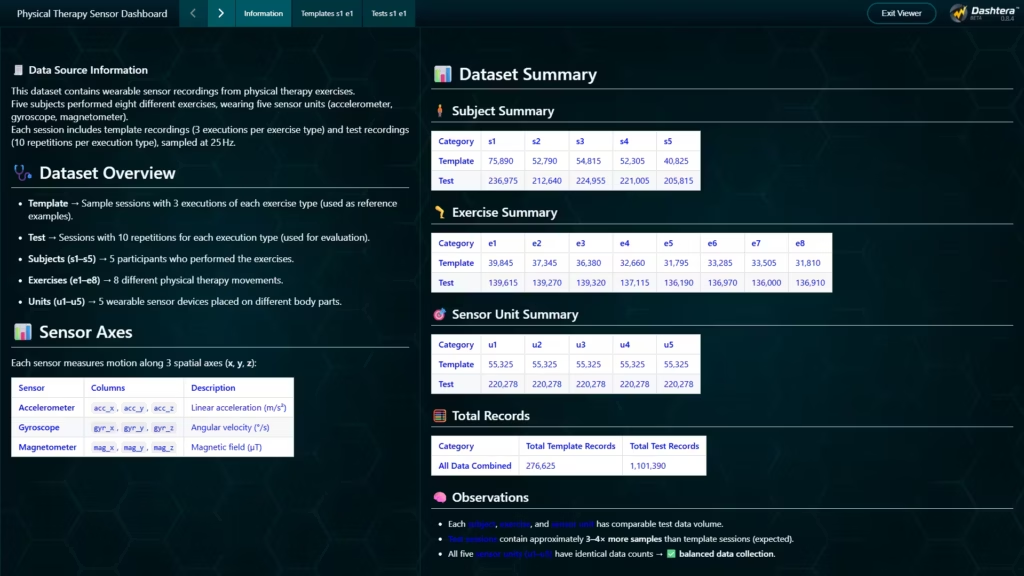
Table 1 presents the distribution of sensor records for template and test sessions for each subject, while Table 2 shows the corresponding distribution across exercises. Table 3 summarizes total record counts.
Table 1. Record distribution by subject
| Subject | Template Records | Test Records |
|---|---|---|
|
s1 |
75,890 |
236,975 |
|
s2 |
52,790 |
212,640 |
|
s3 |
54,815 |
224,955 |
|
s4 |
52,305 |
221,005 |
|
s5 |
40,825 |
205,815 |
Table 2. Record distribution by exercise
| Exercise | Template Records | Test Records |
|---|---|---|
|
e1 |
39,845 |
139,615 |
|
e2 |
37,345 |
139,270 |
|
e3 |
36,380 |
139,320 |
|
e4 |
32,660 |
137,115 |
|
e5 |
31,795 |
136,190 |
|
e6 |
33,285 |
136,970 |
|
e7 |
33,505 |
136,000 |
|
e8 |
31,810 |
136,910 |
Table 3. Total record counts
| Exercise | Template Records | Test Records |
|---|---|---|
|
All Data Combined |
276,625 |
1,101,390 |
The record distributions demonstrate that template sessions are smaller and more controlled, whereas test sessions contain approximately three to four times more samples. Sensor units have identical record counts across subjects, confirming consistent device recording. This balance ensures that subsequent analyses reflect true motion variations rather than sampling inconsistencies.
Key Insight: Template data provide a controlled reference baseline, while test sessions capture variability across repeated executions, supporting comprehensive comparative and variability analyses.
Template Session Analysis (Subject 1 · Exercise 1)
Template session dashboards for subject 1 for exercise 1. display synchronized accelerometer, gyroscope, and magnetometer time-series signals for each sensor unit.
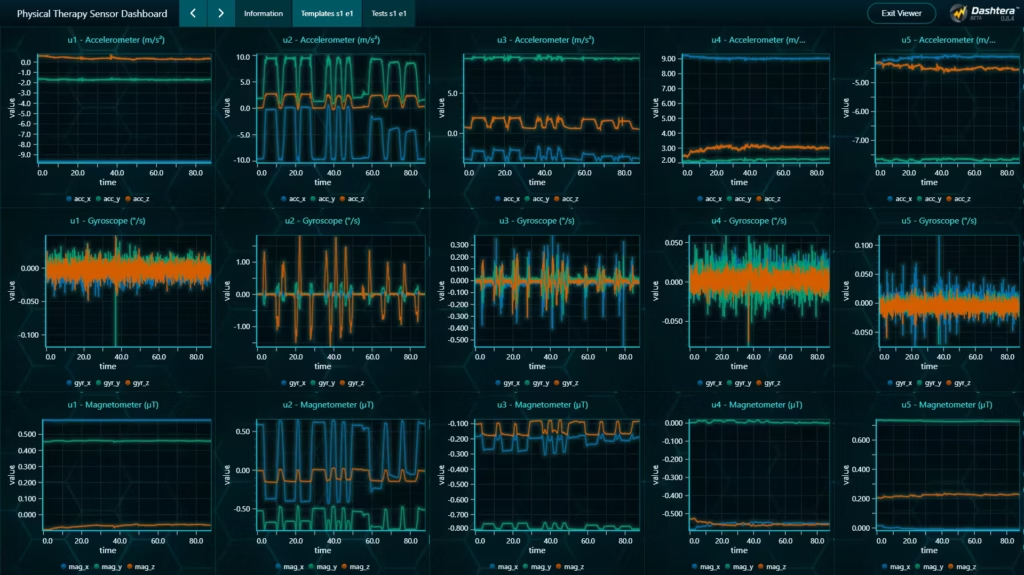
For each subject and exercise, these plots exhibit smooth periodic patterns with minimal noise, indicating consistent execution. Peaks in accelerometer readings align closely with gyroscope rotations, reflecting coordinated limb motion. Magnetometer trajectories further demonstrate stable orientation, corroborating the controlled nature of template sessions.
Key Observations:
These template signals serve as a baseline for subsequent comparisons with test sessions, enabling the identification of deviations from controlled reference movement.
Test Session Analysis (Subject 1 · Exercise 1)
Test session dashboards for subject 1 and exercise 1 exhibit increased variability in amplitude, frequency, and noise compared to template sessions.
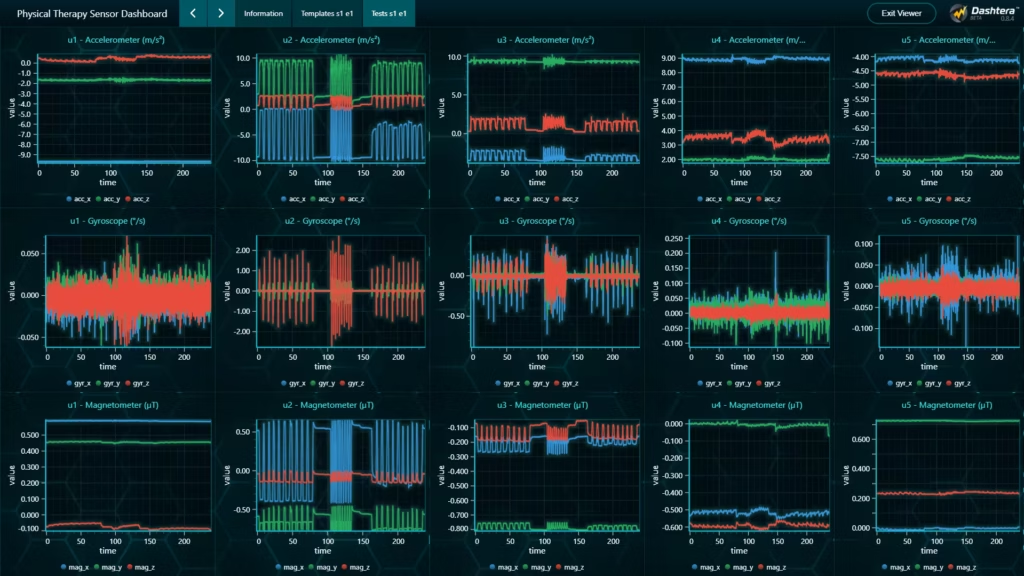
Each subject performed 10 repetitions per exercise, introducing natural fluctuations in movement speed, strength, and rhythm. Visual inspection reveals both inter-subject and intra-subject variability, particularly in distal segments such as the forearm and wrist. Compared with template sessions, higher amplitude and irregular patterns in accelerometer and gyroscope signals reflect realistic exercise conditions.
Key Observations:
3D Motion Visualization (Subject 1)
For subject 1, 3D trajectory dashboards plot sensor data across x, y, and z axes for each sensor unit, providing a spatial representation of limb and body movement.
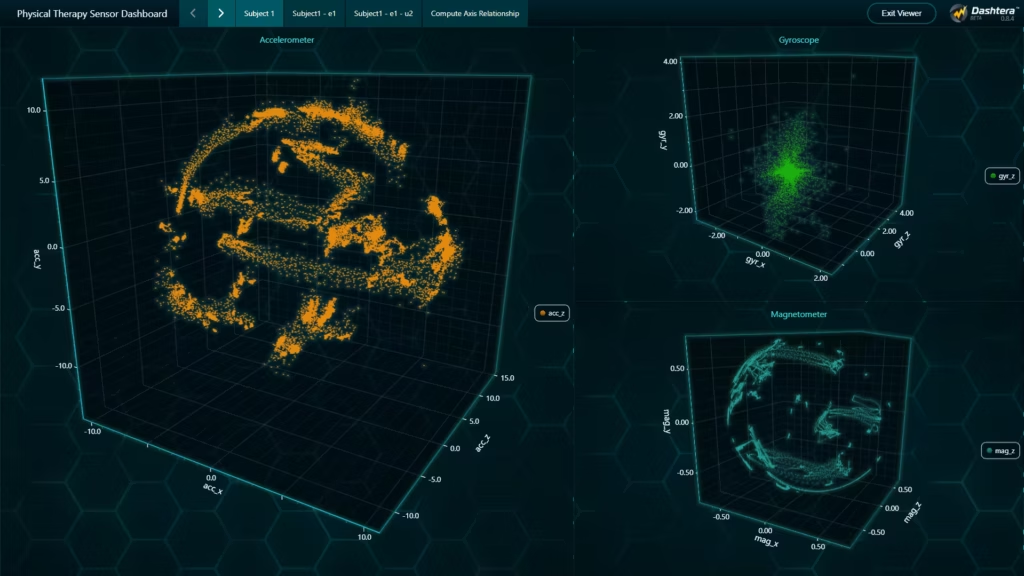
Accelerometer trajectories illustrate cyclic motion patterns, gyroscope plots highlight angular rotation and spread, and magnetometer plots reveal orientation dynamics and environmental field response. These 3D visualizations complement time-series analyses by enabling geometric interpretation of kinematic behavior.
Key Observations:
Sensor Unit Analysis (Subject 1 · Exercise 1)
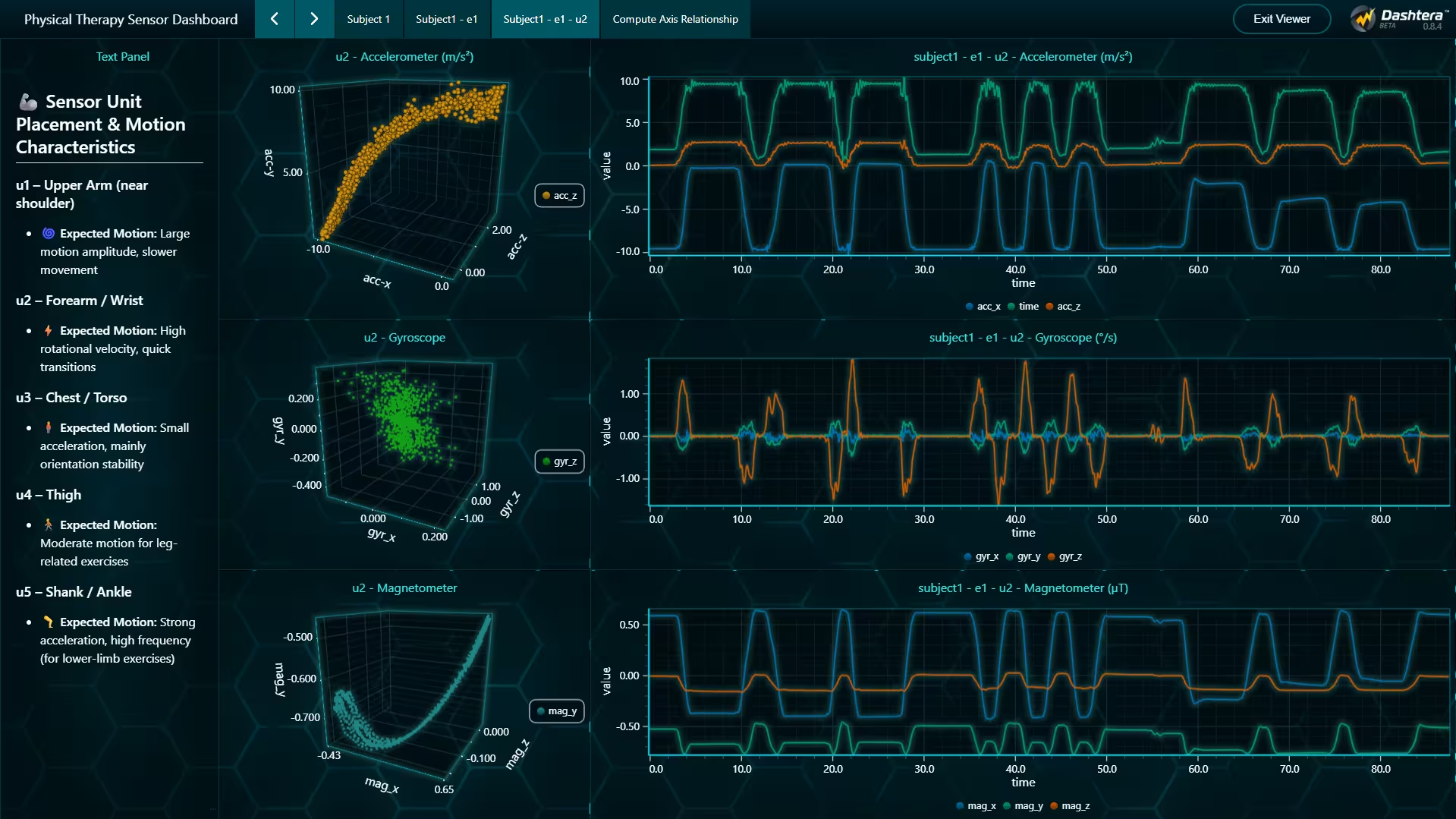
This dashboard examines Subject 1 performing Exercise 1 at the sensor-unit level.
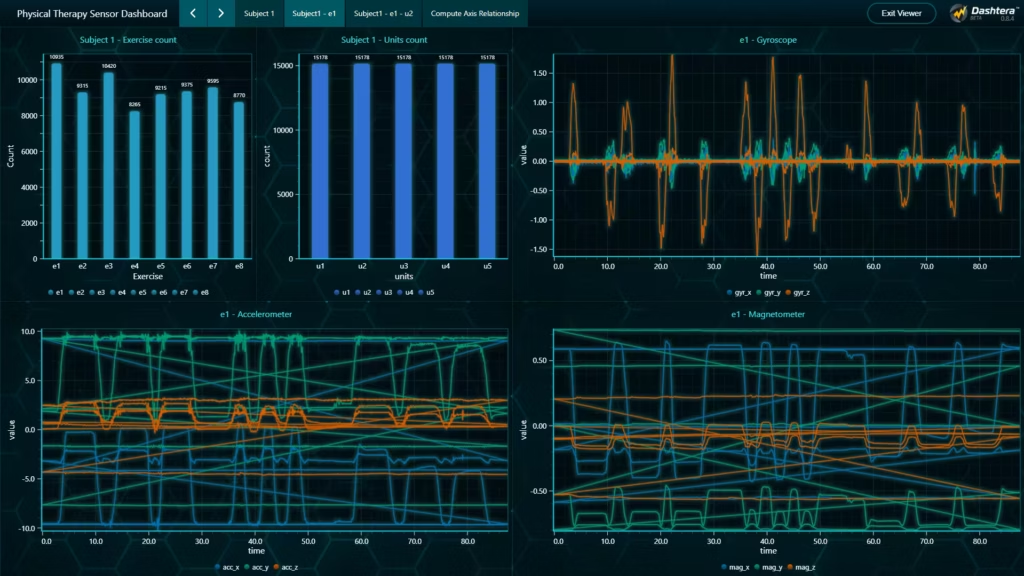
The bar charts summarize record counts per exercise and per sensor, confirming uniform data collection. Time-series plots for each unit display accelerometer, gyroscope, and magnetometer signals, illustrating linear, rotational, and orientation dynamics.
Key Observations:
Sensor Unit Analysis (Subject 1 · Exercise 1 · Unit 2)
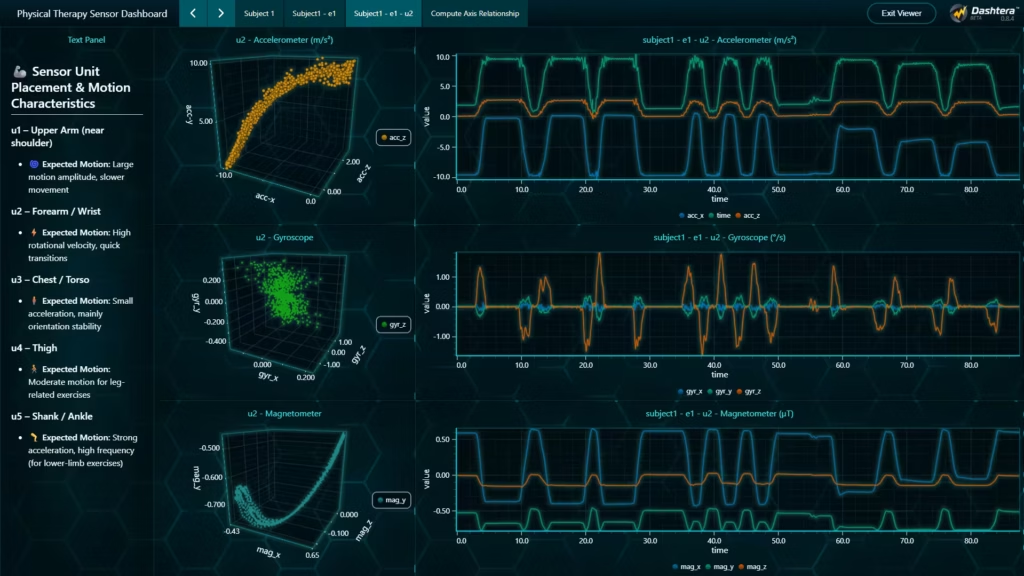
Unit-level dashboards allow examination of motion contributions from individual body segments. Table 4 summarizes sensor placement and motion characteristics.
| Unit | Placement | Motion Characteristics |
|---|---|---|
|
u1 |
Upper Arm |
Large amplitude, slower motion |
|
u2 |
Forearm/Wrist |
High rotational velocity, rapid transitions |
|
u3 |
Chest/Torso |
Minimal motion, orientation stability |
|
u4 |
Thigh |
Moderate leg motion |
|
u5 |
Shank/Ankle |
Strong acceleration, high frequency |
Key Observations:
Inter-Sensor Relationship Analysis (s1 · e1 · u2)
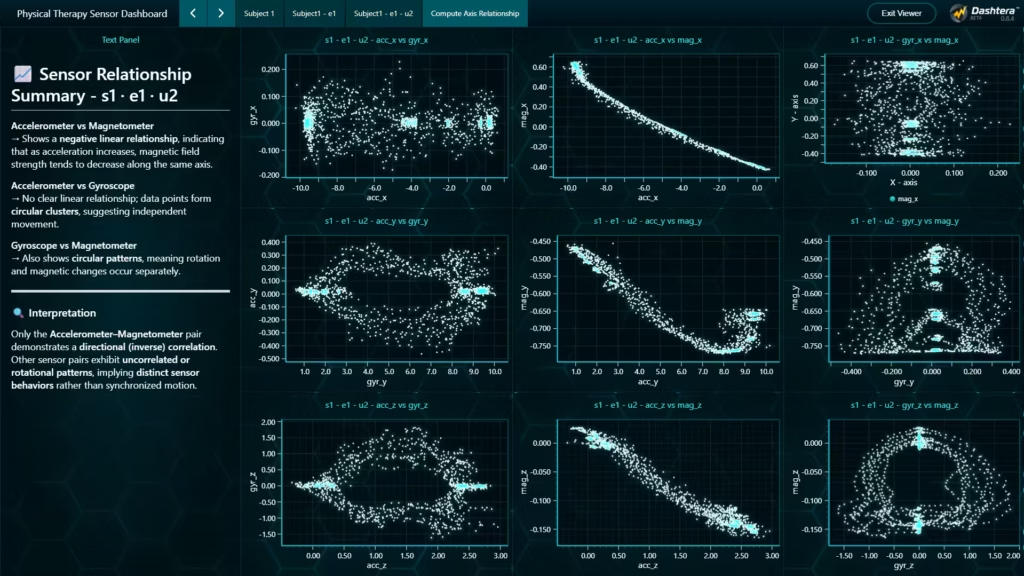
Inter-sensor scatterplots illustrate relationships between accelerometer, gyroscope, and magnetometer measurements along each axis. Table 5 summarizes key relationships.
| Sensor Pair | Relationship | Description |
|---|---|---|
|
acc_x ↔ gyr_x |
No linear correlation |
Linear vs. angular measurement domains are independent |
|
acc_x ↔ mag_x |
Negative linear |
Increased linear acceleration slightly affects orientation |
|
gyr_x ↔ mag_x |
Circular scatter |
Rotational and magnetic signals largely independent |
|
acc_y ↔ gyr_y |
No clear relation |
Orthogonal measurement domains |
|
acc_y ↔ mag_y |
Negative trend |
Minor acceleration–orientation interaction |
|
acc_z ↔ gyr_z |
Slight curve |
Vertical rotation coupling evident |
|
acc_z ↔ mag_z |
Negative slope |
Opposite field direction with acceleration |
|
gyr_z ↔ mag_z |
Circular |
Angular rotation and magnetic field axes largely independent |
Interpretation:
The dashboards collectively demonstrate that the dataset is well structured for analyzing physiotherapy exercise quality. Template sessions provide clean kinematic baselines, while test sessions offer realistic variability useful for performance evaluation or machine learning training. Sensor relationships and unit-wise differences reveal expected biomechanical patterns and confirm proper device calibration.
The Physical Therapy Sensor Data Analysis Dashboard demonstrates the effectiveness of Dashtera as an interactive, no-code platform for analyzing complex motion sensor data. By leveraging Dashtera’s visualization capabilities, users can:
Implications:
Dashtera enables physiotherapists, biomechanics researchers, and data scientists to evaluate motion quality, analyze segment-specific dynamics, and detect deviations from reference exercise patterns efficiently. Its interactive dashboards, combined with a structured, high-resolution dataset, provide a robust foundation for computational modeling, feature extraction, and the development of AI-assisted motion classification or rehabilitation assessment tools.
Summary:
The integration of high-resolution motion sensor data with Dashtera’s interactive, no-code environment transforms complex kinematic signals into actionable insights. By facilitating rapid exploration, comparison, and visualization of human movement, Dashtera significantly enhances both research and applied assessment in physical therapy, supporting data-driven rehabilitation strategies and biomechanical analysis.
Share: